TL;DR
Moisture-wicking socks use engineered fibers and open, breathable knit structures to pull sweat away from the skin, spread it through the fabric, and let it evaporate quickly. This moisture control keeps the in-shoe microclimate drier, lowers friction at the sock–skin interface, and reduces conditions that favor blisters and fungal infections, which supports the foot-health goals behind RockResist trail socks.
Feet contain a very high density of eccrine sweat glands, estimated at roughly 250,000 glands for both feet together, and can produce around half a pint of sweat per day. Trail footwear traps heat and humidity around this sweat-active skin. That environment creates a direct link between moisture, friction, microbial growth, and the common foot problems that many hikers and trail runners experience.
RockResist designs athletic socks for road and trail use with performance attributes that focus on debris control, comfort, and durability. Moisture-wicking and breathability form a core part of that performance stack, because fabric engineering at sock level strongly influences temperature control, friction, and overall microclimate inside the shoe.
What does “moisture-wicking” actually mean in hiking socks?
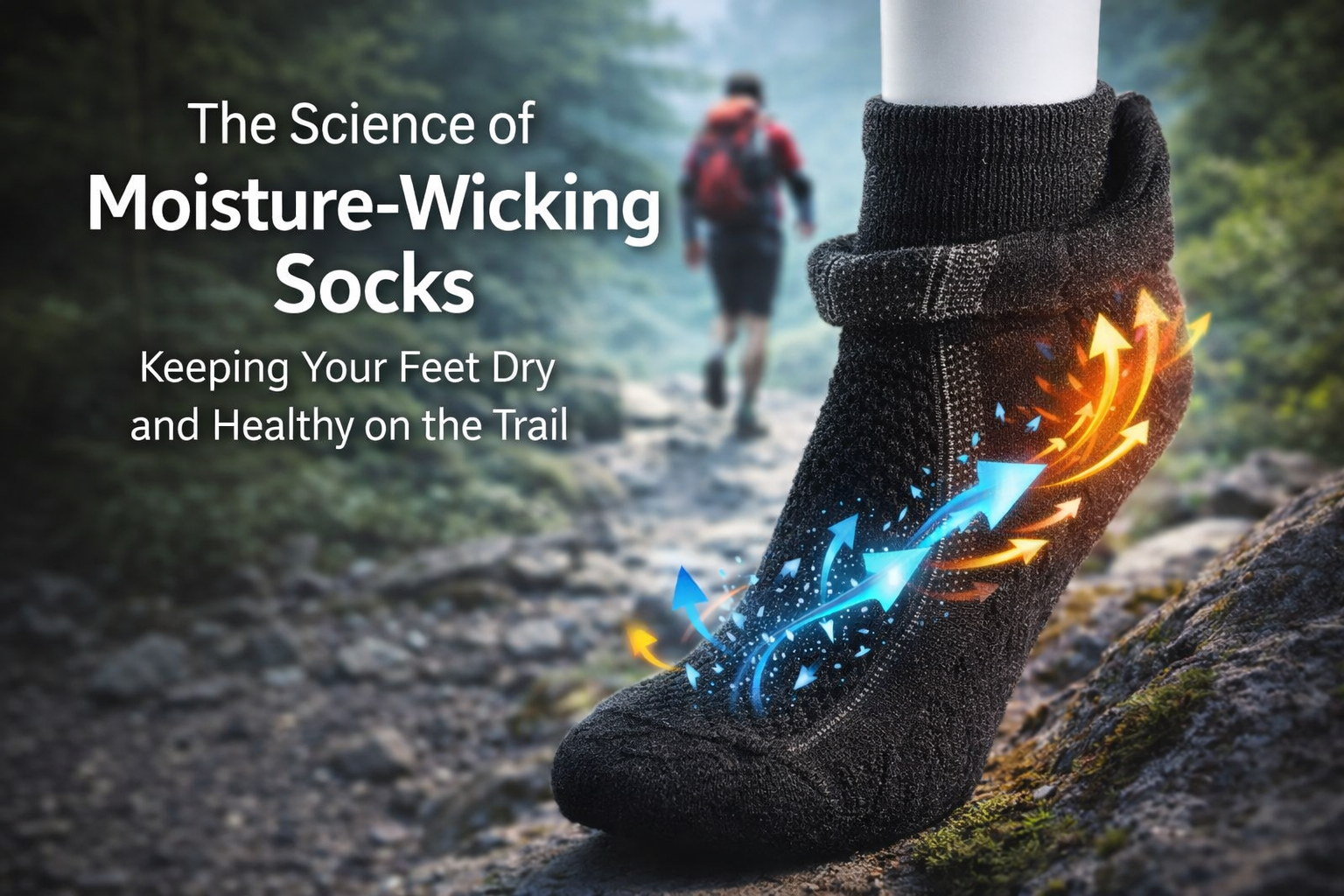
Moisture-wicking in socks means that liquid sweat moves from the skin side of the fabric into and along the yarn structure, then spreads and evaporates quickly at the outer surface.
Textile engineers describe this movement as capillary wicking. Capillary wicking occurs when microscopic channels between fibers pull liquid from areas of higher concentration (the damp skin surface) to drier regions in the fabric and then toward the outside air.
Moisture-wicking socks therefore do two key tasks:
- Limit liquid water on the skin. Lower surface moisture reduces softening and maceration of the stratum corneum.
- Promote rapid drying of the sock. Higher overall moisture-management capacity in fabrics such as polyester, polypropylene, and engineered wool blends helps both liquid transport and water-vapor escape.
Trail socks that only absorb sweat without transporting and evaporating it behave differently. High-absorption, low-wicking fibers (for example, cotton) hold sweat close to the skin and dry much more slowly than synthetic moisture-management yarns.
Why do feet sweat so much on the trail?
Feet sweat heavily on the trail because they combine very high sweat-gland density with mechanical work, shoe insulation, and limited ventilation.
Several factors increase sweat inside trail shoes:
- High gland density: Soles contain more eccrine sweat glands per square centimeter than many other body areas.
- Sustained muscular work: Hiking and running increase core temperature and sympathetic nervous activity, which stimulates eccrine sweat output.
- Closed footwear systems: Trail shoes and boots restrict convective heat loss, which elevates local skin temperature and moisture accumulation.
- Sock and insole materials: Low-permeability foams and dense uppers reduce moisture-vapor transport out of the shoe.
Research on foot sweat distribution shows that sweat output is not uniform. Medial ankle and dorsal foot regions often show higher sweat rates than some plantar regions, which means that sock design must manage moisture across multiple zones, not only under the forefoot or heel.
How do moisture-wicking fibers move sweat away from your skin?
Moisture-wicking sock yarns combine hydrophobic and sometimes hydrophilic fibers in knit structures that create continuous capillary pathways from the skin to the outer surface.
Key fiber-level mechanisms:
- Hydrophobic filaments (for example, polyester, polypropylene, nylon): These fibers do not absorb much water into their core, so water tends to move along their surfaces through capillary channels.
- Hydrophilic components (for example, merino wool, certain rayon types): These fibers can absorb some moisture and spread it into a larger internal volume, which increases the effective evaporation area and moderates humidity swings.
- Engineered cross-sections: Many technical filaments use trilobal, multi-channel, or other non-circular shapes to create extra surface area and capillary spaces for faster wicking.
Knit construction then amplifies this behavior:
- Inner face: Yarns with strong capillary behavior sit next to the skin to pick up liquid quickly.
- Outer face: Yarns and stitches emphasize spreading and evaporation by increasing surface area and access to airflow.
- Zoned structures: Higher-density or terry loops under load-bearing areas manage both impact and moisture, while mesh panels support air exchange over sweat-intense regions such as the dorsal midfoot.
Moisture-wicking performance depends on the full system: fiber chemistry, yarn design, knit pattern, and the way the sock interfaces with the shoe microclimate.
How does moisture-wicking reduce friction and blister risk?
Moisture-wicking reduces blister risk because controlled skin hydration and drier fabric lower friction forces and shear between the sock and superficial skin layers.
Several research findings link moisture and blisters:
- An observational study of 203 long-distance hikers on the Camino de Santiago found that wet socks almost doubled blister risk (odds ratio ~1.94) compared with dry socks, independent of fiber type.
- A 2024 case–control study on 86 hikers reported higher plantar skin hydration values in those who developed blisters versus those who did not, with hydration thresholds above which blister incidence increased markedly.
- Work on sock friction characteristics has shown that increased moisture raises the coefficient of friction for both wool and synthetic fabrics, which heightens shear stress at the epidermis.
Moisture-wicking socks address these mechanisms in three main ways:
- Lowering surface hydration: Rapid transport of liquid sweat toward the outer fabric limits maceration and softening of the stratum corneum, which otherwise makes tissue more vulnerable to shear injury.
- Maintaining more stable microclimate humidity: Fibers with balanced moisture-vapor absorption and transmission keep humidity within a moderate band, rather than allowing alternating periods of over-drying and over-hydration.
- Supporting consistent fit: Technical socks that manage moisture and include structured compression zones reduce bunching and slippage, which lowers localized friction peaks at the heel, metatarsal heads, and toes.
Verywell-style clinical guidance on blister prevention for runners explicitly recommends moisture-wicking socks made from polyester, acrylic, or wool and warns against cotton because of its tendency to retain moisture.
How does moisture control help prevent fungal infections on the feet?
Moisture control helps prevent fungal infections such as tinea pedis (athlete’s foot) because dermatophyte fungi thrive in warm, occluded, and persistently damp environments.
Dermatology references describe several environmental risk factors for tinea pedis:
- Occluded toe spaces: Narrow toe boxes and non-breathable socks increase humidity and maceration between toes.
- Chronic moisture: Repeated cycles of sweat accumulation without complete drying favor fungal adherence and keratin digestion by fungal proteases.
- Microbial overgrowth in shoe microclimate: Higher in-shoe humidity and temperature correlate with increased plantar bacterial load, which can alter the cutaneous microbiome and interact with fungal colonization.
Clinical work on toe-sleeve “finger socks” for interdigital tinea pedis shows higher cure rates when socks reduce humidity between toes, even when hygiene habits remain unchanged.
Moisture-wicking and breathable socks contribute to prevention strategies through:
- Faster drying between toes and across the plantar surface.
- Reduced maceration at toe webs and under callused areas.
- Better integration with breathable footwear that allows moisture-vapor escape.
These measures complement hygiene practices such as daily washing, thorough drying between toes, and rotating shoes between days.
How do breathable sock designs keep the in-shoe climate balanced?
Breathable sock designs maintain a healthier in-shoe climate by pairing moisture-wicking fibers with structures that permit air exchange and water-vapor transport through the sock–shoe system.
Important design factors include:
- Mesh or ventilated zones: Lower stitch density at the instep and ankle promotes convective airflow, which aids evaporation from the outer sock surface.
- Optimized thickness: Medium-thickness road and trail socks balance cushioning and insulation; excessive thickness can trap heat and slow drying, while extremely thin socks may not buffer friction or manage moisture loading effectively.
- Elastic architecture: Targeted elastane zones keep the sock in close contact with the foot so that wicking yarns maintain consistent contact with sweat and do not leave pockets of trapped moisture.
Footwear research shows that poor breathability in shoe uppers raises in-shoe humidity and temperature, which can impair comfort and performance and promote skin problems. Breathable shoes and moisture-managing socks therefore work as an integrated microclimate system.
What moisture-management features characterize RockResist trail socks?
RockResist trail socks combine moisture-management yarns, a performance fit, and anti-debris construction to maintain a cleaner, drier interface between foot, sock, and shoe during road and trail use.
Key functional attributes based on brand materials and user feedback:
- Athletic road-and-trail build: The GEN1 Road and Trail sock is specified as a performance athletic sock for both running and hiking, with medium weight targeted at active use.
- Snug, secure fit: Testimonials describe a close, true-to-size fit that remains stable during trail runs and hilly 10K events, which supports moisture-driven friction control by preventing sock slippage and folds.
- Anti-debris “pocket” and polyurethane barrier: The sock includes a protective barrier and debris-catching pocket that stops sand and pebbles from migrating down the leg and into the shoe, which removes a common source of localized rubbing and micro-trauma.
- Performance-focused construction: The overall RockResist philosophy emphasizes durability, purpose-driven material selection, and real-condition testing, which aligns with the technical requirements of moisture-management socks used over long distances.
RockResist instructs users to hand-wash socks and avoid clothes-washer and dryer cycles because machine washing can damage the polyurethane barrier that provides anti-debris protection and also reduce stretch-to-fit customization when the sock is wet. Care practices that preserve barrier integrity and elasticity help maintain the designed microclimate and fit characteristics over time.
How should hikers choose and use moisture-wicking socks on the trail?
Hikers should select moisture-wicking socks that match activity, climate, and footwear and then use them within a broader foot-care routine that keeps socks dry and shoes ventilated.
Evidence-aligned selection criteria:
- Prioritize moisture-management fibers.
Polyester, polypropylene, nylon, Coolmax-type engineered polyesters, merino, and merino-synthetic blends all show high moisture-management capacity compared with cotton and many other cellulosic fibers. - Avoid high-cotton content for long, hot stages.
Cotton retains several times more moisture than acrylic and Coolmax polyester and dries much more slowly, which keeps feet wetter for longer and increases friction. - Match thickness to footwear volume and temperature.
Medium-cushion socks often work well for trail running and hiking in variable conditions; cold environments may justify thicker structures, and hot, fast-paced efforts may benefit from slightly thinner socks if footwear volume permits. - Use more than one pair on long days.
Long-distance hiking data show higher blister risk when socks remain wet. Changing to a dry pair mid-stage and allowing the first pair to air out reduces exposure to sustained wetness. - Integrate breathable shoes.
Socks cannot overcome completely non-breathable uppers. Footwear studies demonstrate that breathable uppers and more permeable constructions lower in-shoe humidity and plantar skin temperature and support healthier microbial balance.
Usage and care points for RockResist socks:
- Hand-wash inside-out in cool or warm water with mild detergent. This method removes sweat and bacteria from internal fibers while protecting the polyurethane barrier that blocks debris.
- Air-dry away from high heat. Air-drying maintains elasticity and preserves moisture-management performance; tumble drying is not recommended and invalidates return eligibility.
Rotate pairs and inspect regularly. Rotating socks between outings and replacing pairs that show thinning or loss of compression keeps moisture-management and fit performance consistent.
FAQ
How are moisture-wicking socks different from regular cotton socks?
Moisture-wicking socks use fibers and knit structures that transport sweat away from the skin and dry quickly, while regular high-cotton socks mainly absorb and hold sweat next to the skin. Synthetic and merino-blend performance socks show higher overall moisture-management capacity and significantly faster drying than cotton, which remains damp and increases friction and blister risk.
Can moisture-wicking socks alone prevent blisters?
Moisture-wicking socks reduce but do not eliminate blister risk, because blisters arise from a combination of moisture, friction, shoe fit, load, and terrain. Research highlights skin over-hydration, wet socks, and high friction as major contributors, so moisture-managed socks address several key variables, yet shoe fit, lacing, gait, and load management still require attention.
Do merino wool socks or synthetic socks manage moisture better?
Both merino wool socks and synthetic socks can manage moisture effectively, although they do so through slightly different mechanisms and perform differently by design. Studies show that some wool and mohair-wool socks maintain lower in-sock humidity than polyester, while synthetic technical yarns often provide very rapid wicking and drying; blended constructions frequently provide balanced moisture-vapor buffering, odor control, and durability.
How often should hikers change moisture-wicking socks during a long day?
Hikers benefit from changing into dry moisture-wicking socks at least once during very long, hot, or wet stages, especially when feet feel noticeably damp or soft. Long-distance hiking data associate wet socks with nearly double the blister risk, and skin-hydration thresholds above certain values correlate with more blisters, so deliberate sock changes and foot drying breaks form a practical preventive strategy.
Can moisture-wicking socks help with athlete’s foot?
Moisture-wicking and breathable socks support athlete’s-foot prevention and treatment by reducing persistent humidity and maceration, although they do not replace antifungal medication when infection is present. Dermatology references identify occlusion and chronic moisture as key risk factors for tinea pedis, and clinical work with toe-separating socks shows improved cure rates when humidity between toes decreases, which supports the role of moisture-managing socks within a broader care plan prescribed by a clinician.
References
- Baker, L. B. (2019). Physiology of sweat gland function: The roles of sweating and sweat composition in human health. Comprehensive Physiology, 9(1), 65–158.
- Chicharro-Luna, E., Gijon-Nogueron, G., Sanchez-Rodriguez, R., & Martínez-Nova, A. (2022). The influence of sock composition on the appearance of foot blisters in hikers. Journal of Tissue Viability, 31(2), 315–318.
- Gericke, A., et al. (2024). Thermal and moisture management in the microclimate of socks. Fibers, 12(7), Article 53.
- Gracia-Sánchez, A., Martínez-Nova, A., Moya-Cuenca, C., Zúnica-García, S., & Chicharro-Luna, E. (2024). Influence of skin hydration level on the occurrence of blisters on the foot during hiking. International Wound Journal, 21(12), e70024.
- Miao, T., Li, X., Zhu, H., & Wang, B. (2021). Footwear microclimate and its effects on the microbial growth on the foot plantar skin. Journal of Foot and Ankle Research, 14(1), 63.
- Nigam, P. K., Syed, H. A., & Saleh, D. (2023). Tinea pedis. In StatPearls [Internet]. StatPearls Publishing.
- Xiao, Y. Q., et al. (2022). Review on the development and application of directional moisture-wicking textiles. Coatings, 12(3), 301.
- Van Amber, R. R., et al. (2025). Features of a sports performance sock: Friction, moisture, and fiber type. Blister Prevention Pro (technical overview).
- Verywell Health. (2025). 9 proven ways to prevent blisters when running.