TL;DR
Foot health in trail running and hiking depends on three pillars: correct footwear, technical socks plus debris protection, and consistent pre-, mid-, and post-trail foot care. Evidence shows that blisters, nail trauma, and arch pain become far less common when runners and hikers manage moisture, friction, load, and debris in a systematic way
Why does foot health matter so much in trail running and hiking?
Foot health determines how long trail runners and hikers can move without pain, blisters, or overuse injury. Trail terrain increases impact forces, multiplies friction points, and exposes the feet to debris, moisture, heat, and long periods of loading.
Research in running and hiking populations shows that friction blisters alone affect roughly 16–76% of runners and 29–95% of hikers, and often represent the single most common injury during events. These blisters reduce performance, alter gait, and increase the risk of secondary injuries.
Healthy feet for trail sports require:
- Structural support for the arch, ankle, and forefoot.
- Stable contact with uneven ground.
- Controlled moisture and temperature at the skin–sock–shoe interface.
- Protection from grit, rocks, and plant material.
- Daily inspection and early treatment of minor issues.
How common are trail-related foot problems and what are the main risks?
Trail runners and hikers most frequently experience friction blisters, toenail trauma, plantar fascia pain, Achilles tendon irritation, and ankle sprains.
Key risk factors include:
- Extended duration and vertical gain: Longer time on feet and steep climbing/descending increase repetitive load on plantar fascia, Achilles tendon, and forefoot joints.
- High friction and shear: Repetitive rubbing between skin, sock, and shoe generates blisters, especially under the ball of the foot, heel, and toes.
- Moisture and heat: Sweat, rain, and stream crossings soften the skin and amplify friction damage.
- Poor footwear fit: Oversized shoes allow sliding; tight shoes compress nails and bony prominences; both patterns contribute to blisters and bruised toenails.
- Debris in footwear: Sand, gravel, and organic material increase shear forces, cause hot spots, and damage skin.
Foot health strategies for trail sports must address each of these factors in a structured way.
How should trail runners and hikers choose footwear for foot health?
Footwear for trail running and hiking must match arch type, terrain, and load while providing secure midfoot hold and adequate toe box space.
Evidence-based footwear selection principles include:
- Match shoe type to arch and gait. Guidance from podiatric organizations recommends stability or motion-control shoes for low arches and over-pronation, balanced cushioning for neutral arches, and cushioned shoes with less motion control for high arches.
- Prioritize secure midfoot and heel lockdown. A stable heel and midfoot reduce sliding on descents and limit shear forces that cause blisters and tendon overload.
- Leave functional toe box space. One half to one full size extra length provides room for toe splay and swell, reduces nail trauma on descents, and limits pressure on the distal nail edges.
- Select appropriate sole and rock protection.
- Rock plates or firmer midsoles protect the plantar surface on rocky trails.
- Aggressive lugs increase traction on mud and loose gravel.
- Rock plates or firmer midsoles protect the plantar surface on rocky trails.
- Test footwear under trail-like conditions. Short test runs or hikes on similar climbs and descents verify that no pressure points, heel lift, or forefoot sliding occur.
Footwear selection establishes the baseline; socks and debris protection modify the micro-environment that determines skin health.
Which sock strategies best protect feet on rough trails?
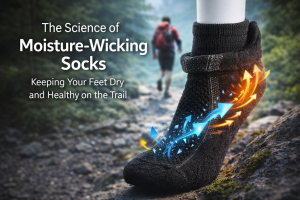
Technical socks protect feet on trails by controlling moisture, reducing friction, adding targeted cushioning, and helping manage debris.
Do moisture-wicking and anti-blister socks really reduce friction?
Moisture-wicking socks made from merino wool or technical synthetic fibers reduce blister risk compared with cotton socks that retain sweat.
Outdoor medicine research and systematic reviews identify the following sock-related principles:
- Dry socks reduce blisters. Wet socks increase blister risk; changing into dry socks on long days reduces incidence.
- Fiber type matters less than dryness. One study found wet socks heighten blister risk in hikers irrespective of fiber composition, and recommended regular sock changes to keep feet dry.
- Sock design influences friction. Thick, plush cushioning, double-layer designs, and seamless or low-seam construction reduce shear forces over high-risk areas.
- Activity-specific socks perform better. Hiking and running socks are designed with different densities, heights, and compression zones to match typical footwear and movements.
Key practical guidelines:
- Select merino wool or synthetic blends labeled as moisture-wicking.
- Avoid cotton socks for long trail efforts.
- Use light to medium cushioning for most trail running and day hiking; increase cushioning for multi-day backpacking under heavy load.
- Ensure socks fit snugly without wrinkling at the heel, under the arch, or at the toes.
How do debris-blocking solutions like gaiters and debris-barrier socks help?
Debris-blocking strategies such as gaiters and integrated debris-barrier socks reduce blister risk by preventing grit, sand, and small stones from entering the shoe.
Expert guidance from outdoor organizations describes gaiters as lightweight covers that form a barrier from the shoe to above the ankle or higher, blocking debris and reducing friction-inducing contaminants around the foot.
Two main options exist:
- External gaiters: Attach to shoes and wrap around the ankle and lower leg to keep dirt, mud, and water away from socks and skin.
- Debris-barrier socks: Use a built-in cuff or polyurethane barrier at the top of the sock to capture fine gravel and sand before it reaches the sock–skin interface.
Debris-blocking systems support foot health by:
- Reducing hot spots caused by localized grit.
- Lowering the frequency of stops to remove stones.
- Maintaining a more stable friction profile inside the shoe.
How can trail runners and hikers prevent blisters systematically?
Blister prevention on trails depends on combined management of friction, moisture, load, and skin preparedness.
Research and systematic reviews highlight several effective strategies:
- Optimize footwear and socks.
- Use well-fitted, trail-appropriate shoes.
- Choose moisture-wicking technical socks with adequate cushioning and minimal seams.
- Change into dry socks on long days or after immersion.
- Use well-fitted, trail-appropriate shoes.
- Control moisture.
- Air feet during long stops.
- Use antiperspirant preparations on soles in some cases, according to medical advice from a podiatrist or sports physician.
- Avoid prolonged walking or running in wet socks when alternative pairs are available.
- Air feet during long stops.
- Pre-protect high-risk areas.
- Apply blister tape, hydrocolloid dressings, or thin moleskin over previously problematic areas before starting.
- Ensure dressings are wrinkle-free and lie smoothly under the sock.
- Apply blister tape, hydrocolloid dressings, or thin moleskin over previously problematic areas before starting.
- Use lubricants or powders strategically.
- Apply anti-friction creams or balms to areas not already taped, according to product instructions.
- Use drying powders where moisture accumulation is a main issue, avoiding clumping inside socks.
- Apply anti-friction creams or balms to areas not already taped, according to product instructions.
- Manage load and progression.
- Increase volume, elevation gain, and technical difficulty gradually to allow skin and soft tissues to adapt.
- Alternate terrains and footwear across the week to distribute load.
- Increase volume, elevation gain, and technical difficulty gradually to allow skin and soft tissues to adapt.
- Respond early to hot spots.
- Stop and treat any early burning or rubbing sensation with tape or dressing instead of continuing until a full blister forms.
- Stop and treat any early burning or rubbing sensation with tape or dressing instead of continuing until a full blister forms.
Friction-blister literature emphasizes that combined strategies are more effective than a single tactic used in isolation.
How can nails, skin, arches, and tendons be protected on the trail?
Targeted care for nails, skin, arches, and tendons reduces the risk of chronic problems such as plantar fasciitis, Achilles tendinopathy, and nail trauma.
What nail and skin care routines should trail athletes follow?
Nail and skin care for trail sports focuses on length control, smooth surfaces, and clean, dry conditions. Clinical advice for runners consistently recommends:
- Trimming toenails straight across to just beyond the tip of the toe, avoiding overly short or rounded corners.
- Smoothing rough edges with a file to prevent catching on socks.
- Washing and thoroughly drying feet, particularly between toes, after runs and hikes.
- Moisturizing soles to reduce fissures while keeping the spaces between toes dry to reduce fungal risk.
- Checking daily for calluses, cracks, redness, or small wounds and addressing them early.
How can trail athletes protect arches and tendons such as the plantar fascia and Achilles tendon?
Supportive footwear, progressive training loads, and regular strengthening and stretching reduce plantar fascia and Achilles tendon stress. Evidence-based guidance includes:
- Wearing shoes with appropriate arch support and rearfoot stability for the individual foot type.
- Incorporating calf, Achilles, and plantar fascia stretches into warm-up and cool-down routines.
- Adding specific foot and ankle strengthening exercises, such as calf raises, resisted inversion/eversion, and short-foot exercises.
- Avoiding sudden increases in weekly distance, vertical gain, or speed, particularly on steep or technical terrain.
What daily and post-trail routines support long-term foot health?
Daily routines that clean, dry, strengthen, and inspect the feet form the foundation of durable foot health for trail running and hiking.
Effective routines include:
- Post-activity cleansing and drying: Wash feet with mild soap, dry carefully including between toes, and change into clean, dry socks.
- Sock care according to manufacturer instructions: Hand washing performance socks, using cold or warm water, and air drying helps preserve elasticity, moisture-management fibers, and any functional barriers, which maintains consistent friction and debris protection over time.
- Rotating footwear and socks: Allowing shoes and socks to dry fully between uses reduces microbial growth and odor.
- Regular inspection: Checking soles, toes, and heels for calluses, blisters, splits, or color changes enables early intervention.
- Foot-specific strength work: Including short sessions of intrinsic foot muscle training two to three times per week supports arch function under trail loads.
When should trail runners and hikers see a foot specialist?
Trail runners and hikers should consult a podiatrist or sports medicine professional when pain persists, recurring blisters form in the same locations, or structural deformities appear.
Clear referral indicators include:
- Heel, arch, or forefoot pain lasting more than one to two weeks despite reduced load.
- Frequent recurrence of blisters, even after implementing evidence-based prevention strategies.
- Progressive nail changes, severe bruising, or ingrown nails.
- Visible deformities such as bunions or hammertoes that interfere with shoe fit.
- Numbness, burning, or tingling in the feet.
Specialists can provide gait assessment, orthotic recommendations, footwear guidance, and targeted treatment plans tailored to trail demands.
FAQ
How can beginners prepare their feet before starting trail running or hiking?
Beginners prepare feet for trail sports by building load gradually, conditioning skin, and optimizing footwear and socks from the start.
Start with shorter, less technical routes and progressively add distance and elevation. Use properly fitted trail shoes, technical moisture-wicking socks, and, when necessary, simple pre-taping of high-risk areas. Perform basic foot and calf strengthening exercises several times per week to support arches and tendons.
How often should trail runners and hikers change socks during a long day?
Trail athletes benefit from changing socks whenever socks become saturated, after full immersion, or at least once during very long outings.
Changing into dry socks after several hours on wet or hot trails restores a drier environment at the skin–sock interface, which reduces blister risk and improves comfort, especially when combined with airing feet and re-taping any emerging hot spots.
Are double-layer or liner-plus-outer sock systems better than single socks?
Double-layer socks and liner-plus-outer systems can reduce friction for some athletes, but effectiveness depends on fit and total bulk.
Systematic reviews describe double layers, specific fibers, and barrier tapes as viable blister-prevention strategies. However, excessive thickness may alter shoe fit and introduce new pressure points. Testing different combinations in training on similar terrain remains essential before race or expedition use.
How can trail athletes manage foot health in wet, muddy, or snowy conditions?
Foot health in wet conditions relies on moisture management, thermal protection, and debris control.
Use water-resistant or faster-draining footwear as appropriate to the environment, pair them with merino or synthetic socks that retain insulating value when damp, and add gaiters or debris-barrier socks to minimize ingress of snow, mud, and grit. Change into dry socks and footwear as soon as conditions and logistics allow.
What is the best way to treat a blister that develops during a run or hike?
Blister treatment on the trail should protect the blister roof, reduce pressure, and maintain cleanliness.
If the blister roof is intact, cover the area with a donut-style felt pad or cushioned dressing that offloads pressure, and secure it with tape. If the blister has ruptured, clean the area, smooth the remaining skin, apply an appropriate dressing, and monitor closely for signs of infection such as increasing redness, warmth, or pus. Seek medical care if infection is suspected.
References
- Rushton, R., & Richie, D. (2024). Friction blisters of the feet: A new paradigm to explain causation. Journal of Athletic Training, 59(1), 1–7.
- Worthing, R. M., Percy, R. L., & Joslin, J. D. (2017). Prevention of friction blisters in outdoor pursuits: A systematic review. Wilderness & Environmental Medicine, 28(2), 139–149.
- American Podiatric Medical Association. (n.d.). Which running shoe is right for you?
- REI Co-op. (n.d.). How to choose hiking socks.
- Esther, C. L., et al. (2022). Influence of sock composition and wetness on blister formation in hikers. Footwear Science.
- Edmonton Foot Clinic. (2024, November 29). Foot health for runners: Avoiding and treating common injuries.
- REI Co-op. (n.d.). How to choose and use gaiters.