
Table of Contents
- Injinji vs Smartwool for Trail Running: The Core Difference
- Toe Socks vs Merino Wool Running Socks: How They Handle Blisters
- Synthetic vs Merino Wool Trail Socks: Moisture, Odor, and Drying Time
- Running Sock Thickness for Trail Running: Cushioning Without the Bulky Feel
- Best Socks for Trail Running Blisters: Fit, Cuff Elasticity, and Hot Spots
- Wet-Weather Performance, Durability, and Cost Per Wear
- How to Choose: Decision Guide by Foot Shape and Blister Location
- Frequently Asked Questions
Last Updated: October 15, 2026
Injinji vs Smartwool for Trail Running: The Core Difference
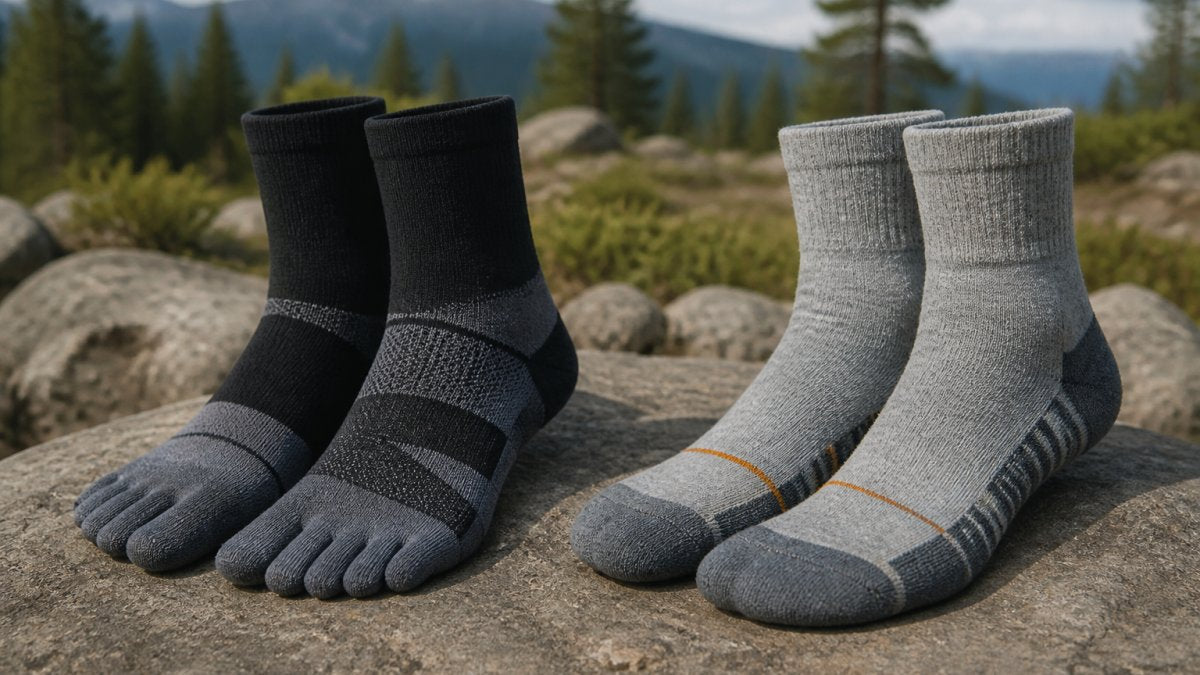
The core difference in the Injinji vs Smartwool for trail running debate comes down to structure versus material. Injinji separates each toe with fabric; Smartwool wraps the whole foot in merino wool. That single design choice explains almost everything else about how the two perform on technical trails.
At RockResist, we build socks around a third idea: a debris-shielding cuff that stops grit at the shoe collar before it ever reaches your toes. More on that later.
Here is what matters most. Toe separation targets friction between toes. Merino targets moisture and odor. Neither design fully addresses debris entering the shoe, which is the hidden cause of many hot spots on loose, rocky terrain.
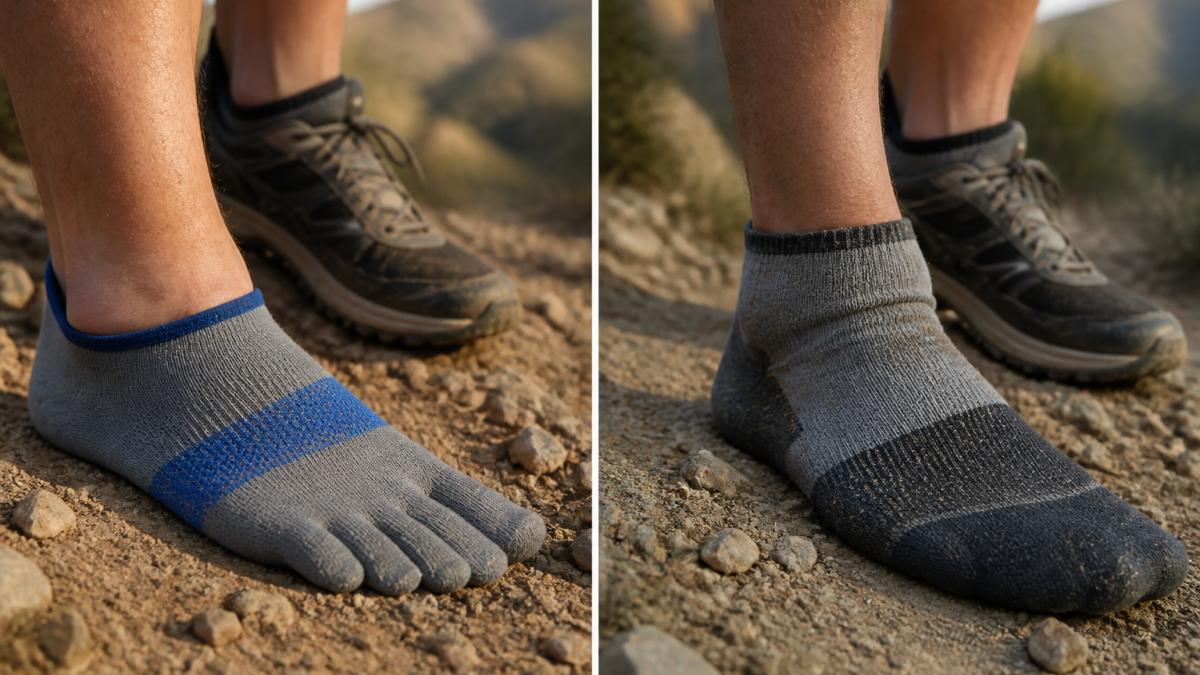
Both approaches have loyal followings, and both work. The question is which one fits your feet, your trails, and your blister history.
Toe Socks vs Merino Wool Running Socks: How They Handle Blisters
Toe socks fight blisters by eliminating skin-on-skin contact between toes. Merino wool running socks fight blisters by managing moisture so skin stays drier and friction drops.
Toe socks are socks with individual fabric sleeves for each toe. The design keeps toes separated, which removes the rubbing that causes blisters between adjacent toes.
Merino wool running socks use fine wool fibers that absorb moisture vapor and resist odor. The fabric stays comfortable when damp, but toes still touch each other inside the sock.
A common mistake is assuming one design covers every blister. It does not.
- Blisters between toes: toe separation helps most
- Blisters on heels and arches: fit and moisture management matter more
- Blisters from grit and sand: neither design fully solves it
Synthetic vs Merino Wool Trail Socks: Moisture, Odor, and Drying Time
Synthetic vs merino wool trail socks is really a trade-off between drying speed and damp comfort. Synthetics like nylon and polyester move sweat quickly and dry fast. Merino absorbs moisture, resists odor, and feels softer when wet.
The mechanism matters more than the label. Merino's fine fibers pull moisture vapor into the core of the fiber, so the surface stays relatively dry against your skin even as the sock gains weight. Synthetics move liquid sweat along the fiber surface and release it to the air, which is why they dry faster but feel clammy once they are saturated. Neither fiber is waterproof. Once a sock is saturated, both feel heavy.
| Fiber | Drying Speed | Odor Resistance | Feel When Wet |
|---|---|---|---|
| Merino wool | Slower | Strong | Soft, warm |
| Synthetic (nylon, polyester) | Faster | Weaker | Cooler, clammy |
| Wool blend | Moderate | Good | Balanced |
Many runners land on a blend for the middle ground. A wool blend keeps some odor resistance while drying faster than pure merino. On a multi-day trip where you cannot wash socks, that odor resistance is not a luxury, it is the difference between wearing a pair on day three and throwing it away.
For wet-weather performance, synthetics and blends have an edge on drying time. Merino holds more water before it feels soaked, which helps on shorter wet runs. On a long run with repeated stream crossings, a saturated merino sock can feel like a wet sponge for miles, while a thin synthetic sheds water and dries against your foot as you move. The practical rule: if your trails are wet and your runs are long, lean synthetic or blend; if your runs are shorter and odor is your main concern, merino earns its place.
Running Sock Thickness for Trail Running: Cushioning Without the Bulky Feel
Running sock thickness for trail running should match your shoe volume, not your ego. Too much cushioning creates a bulky feel and crowds the toe box. Too little leaves your feet exposed on sharp rock.
Cushioning levels break into three practical tiers:
- Lightweight: minimal padding, best for firm trails and racing
- Midweight cushioning: padding at heel and forefoot, the common all-rounder
- Heavy cushioning: maximum padding for long days on sharp, technical terrain
The most common mistake is sizing up shoes to fit thicker socks. That trade usually creates heel slippage, which causes its own blisters.
Best Socks for Trail Running Blisters: Fit, Cuff Elasticity, and Hot Spots
The best socks for trail running blisters are the ones that stay put. Fit and cuff elasticity matter more than brand loyalty, because a sock that slides creates friction with every step.
RockResist GEN1 Trail Running Socks, Debris-Blocking Low Cut →
Three fit factors decide whether a sock protects or punishes:
- Heel lock: the sock should cup your heel without bunching
- Cuff elasticity: a firm but not tight cuff keeps the sock from migrating
- Toe box room: toes need space to splay without pressing the fabric
Hot spots usually appear where these three fail. A slipping heel, a loose cuff, or cramped toes all generate friction long before a blister forms.
This is where debris-shielding design earns its place. RockResist GEN1 socks use an integrated barrier that helps block dirt, sand, and small trail debris from entering at the shoe collar, with added heel material to reduce friction at the collar. You can wear the barrier up for loose terrain or tuck it in for a lower profile.

Wet-Weather Performance, Durability, and Cost Per Wear
Wet-weather performance separates socks that survive a season from socks that survive a decade. Drying time, abrasion resistance, and construction quality all feed into cost per wear.
Durability shows up in three places on trail socks:
- Heel and ball of foot: the highest-abrasion zones, where dense knits and reinforced yarns resist pilling and thin spots
- Toe seams: where toe-sock construction adds more seams and therefore more potential failure points than a conventional tube sock
- Cuff and collar: where repeated tugging and debris contact break down elastic
A common pattern is that merino socks develop thin spots at the heel before they tear, while synthetic and blended socks tend to pill at high-friction zones first. Neither failure mode is fatal if you catch it early. Rotate two or three pairs and you roughly double the calendar life of each pair.
Cost per wear is the honest metric. A cheap sock replaced twice a season often costs more than a durable pair that lasts years. RockResist recommends hand-washing and line-drying, since machine washing and tumble drying can negatively affect the product. To run the math yourself, divide the purchase price by the number of runs you realistically get before the sock thins at the heel or loses cuff elasticity. A $30.00 pair worn 60 times works out to $0.50 per run. A $15.00 pair that only lasts 20 runs costs $0.75 per run. Durability beats sticker price almost every time.
For sizing, RockResist GEN1 runs unisex: S fits women's 7-9 and men's 5-7, M fits women's 10-12 and men's 8-10, and L fits women's 13-15 and men's 11-13. If you sit between sizes, size to the larger range for trail use.
The GEN1 low-cut pair is $30.00, and the 3-pair bundle is $67.50, a 25% savings versus buying three pairs individually. A current bundle offer includes a free wrist band with every 3-pair bundle.

How to Choose: Decision Guide by Foot Shape and Blister Location
Choosing between toe socks and merino comes down to your blister pattern and foot shape. Use this decision guide rather than defaulting to whichever brand you already own.
- Blisters between toes: choose toe separation
- Blisters on heels or arches: prioritize fit and cuff elasticity, not toe design
- Wide forefoot: light or midweight cushioning to avoid a cramped toe box
- Narrow foot: midweight cushioning with a firm cuff to prevent sliding
- Heavy sweater: synthetic or blend fibers for faster drying
- Odor-prone feet: merino or a wool blend
- Loose, sandy, or rocky trails: prioritize debris-blocking construction at the collar
Frequently Asked Questions
Are Injinji or Smartwool socks better for trail running?
It depends on what causes your foot problems. Injinji toe socks separate each toe with fabric, which cuts friction between toes and helps with blisters in that area. Smartwool merino wool socks manage sweat and odor well and suit runners who prefer a traditional single-tube fit. Neither is universally better. Runners who blister between toes tend to prefer toe separation, while those who blister on the heel or arch often do fine in merino wool with a secure fit.
Do toe socks help prevent blisters when trail running?
Toe socks reduce friction between toes because each toe sits in its own sleeve instead of rubbing against its neighbor. That helps most with blisters that form between toes, especially on long runs over technical terrain. They do not prevent heel or arch blisters, which come from shoe fit and sock movement. Pairing toe socks with a snug shoe and a sock that stays put, like one with non-slip construction, covers more of the problem.
Are merino wool socks good for trail running?
Merino wool regulates temperature, resists odor, and stays warm when damp, which suits cold or mixed-condition trail runs. Its main drawback is drying time: once soaked, wool takes longer to dry than synthetic fibers like nylon or terylene. For wet-weather races or creek crossings, many runners choose a wool blend or a synthetic sock instead. If you run mostly dry trails, merino works well.
Should trail running socks fit tightly?
They should fit snugly without pressure points. A tight fit keeps the sock from sliding, which is a major cause of hot spots and blisters. But if the cuff digs in or toes feel compressed, you lose circulation and comfort on long efforts. Check that the heel stays seated and the cuff sits flat. Sizing between two sizes is common, so measure your foot and match it to the brand's chart rather than guessing.
Trail conditions punish gear that only works in the store. If debris and blisters keep interrupting your miles, RockResist builds socks for exactly that problem, with debris-shielding cuff technology, moisture-management fibers, and reinforced seams tested on rugged Colorado trails. Get started with RockResist and keep grit out of your run.