

Table of Contents
- Why Trail Runners Face a Sweat vs Debris Trade-Off
- How Moisture-Wicking Running Socks Manage Sweat on the Trail
- Trail Running Socks That Keep Dirt Out: How Debris-Blocking Works
- Direct Comparison: Sweat-Wicking Performance vs Debris-Blocking Ability
- Running Gaiters for Trail Debris: When Socks Alone Aren't Enough
- How to Keep Rocks Out of Running Shoes: A Practical Checklist
- Trade-Offs in Hot, Wet, and Dusty Conditions
- Conclusion: Matching the Right Feature to Your Terrain
- Frequently Asked Questions
Last Updated: October 4, 2026
Why Trail Runners Face a Sweat vs Debris Trade-Off
Every trail runner confronts the same truth: the sock that keeps your feet dry is rarely the debris-blocking socks that keep grit out.
The core conflict: moisture-wicking running socks pull sweat away from skin through capillary action in the yarn, which needs airflow.

The American College of Sports Medicine position stand on exercise and fluid replacement notes that feet sweat heavily during sustained aerobic activity, which makes moisture management a real performance concern rather than a comfort detail. And the National Park Service trail safety guidance reminds runners that loose scree and dust are constants on technical terrain.
Below, we compare how each feature performs, when to add gaiters, and how to keep rocks out of your shoes.
How Moisture-Wicking Running Socks Manage Sweat on the Trail
Moisture-wicking running socks move sweat away from your skin and spread it across the fabric surface, where it evaporates faster. The mechanism is straightforward: fiber chemistry plus fabric structure.
Fabric and Yarn Choices That Move Moisture
Merino wool and synthetics like polyester and nylon handle moisture differently. Synthetics move liquid sweat quickly and dry fast but hold odor; merino absorbs vapor, regulates temperature, and resists odor naturally, though it dries slower when soaked.
Look for mesh panels and engineered zones: mesh across the top of the foot moves moisture where it can escape, while denser knit under the arch adds cushioning.
Where Wicking Hits Its Limits
Wicking fails when the fabric saturates: a soaked sock stops transferring moisture and starts holding it against your skin, and blister prevention breaks down.
The fix isn't a better sock alone, but pairing quick-drying fabric with shoes that drain and ventilate. A soaked sock plus a non-breathing upper equals wet feet no matter what the label claims.
Trail Running Socks That Keep Dirt Out: How Debris-Blocking Works
Trail running socks that keep dirt out rely on one principle: close the opening where debris enters. Most grit gets in at the shoe collar, not through the fabric itself. A debris-blocking design adds a barrier at that exact point.
Cuff Construction and the Shoe-Sock Gap
The shoe-sock gap is the space between your sock's top edge and your shoe's collar.
A debris-shielding cuff extends above the collar and hugs the ankle, blocking the entry path; some designs let you wear the barrier up for loose terrain or tuck it down for a lower profile.
What most guides miss is that debris entry is a fit problem before it's a fabric problem. A loose sock with a tall cuff still lets grit in.
Direct Comparison: Sweat-Wicking Performance vs Debris-Blocking Ability
Most reviews treat wicking and debris-blocking as separate virtues. Below is a head-to-head comparison built around the mechanisms each depends on, the conditions where each wins, and the criteria you can check before you buy.
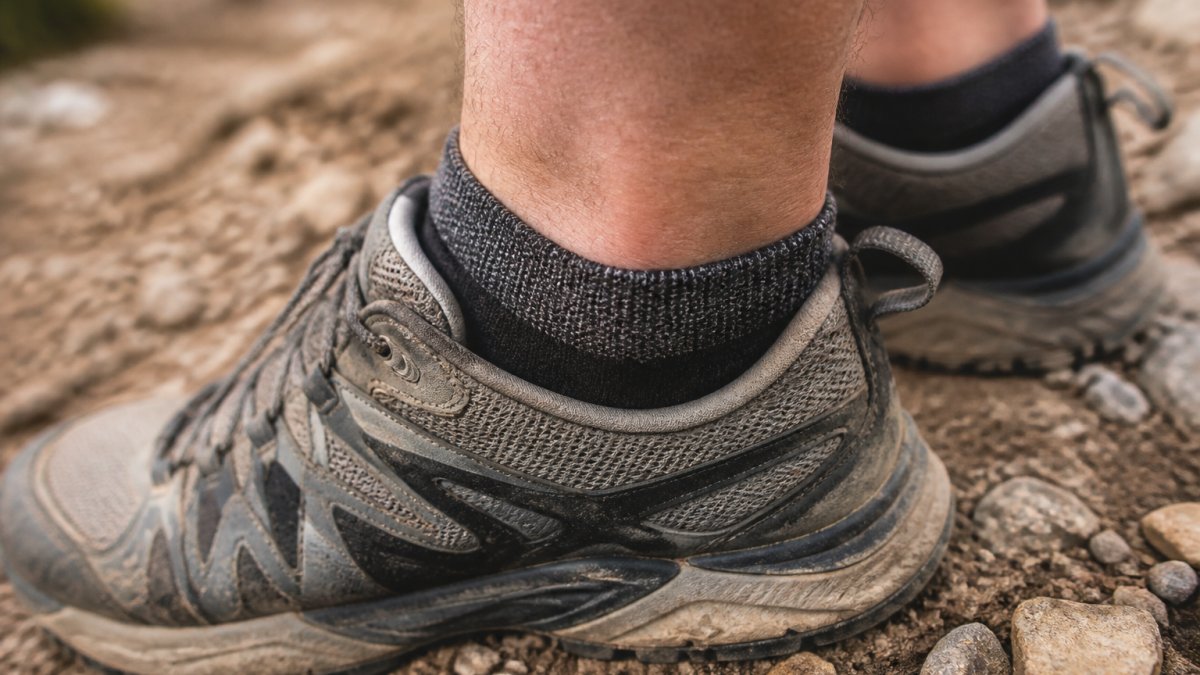
The Comparison, Built on Mechanisms
| Factor | Sweat-Wicking Focus | Debris-Blocking Focus |
|---|---|---|
| Primary job | Move liquid sweat off skin via capillary action in the yarn | Seal the shoe-sock gap where grit enters |
| What it depends on | Airflow, mesh panels, yarn surface area | Cuff height, snug fit, non-slip grip |
| Best terrain | Hot, humid, road-to-trail, sustained climbs | Loose, dusty, rocky, scree fields |
| Failure mode | Saturates, stops transferring, holds moisture against skin | Reduces ventilation, can trap heat and sweat |
| Blister mechanism | Friction from wet, softened skin | Friction from embedded grit and sand |
| Key spec to check | Mesh zones, yarn blend, seamless toe | Cuff height above collar, elastic grip band |
| Time to failure | Minutes once fully saturated | Immediate on the first loose step |
What "Performance" Actually Means for Each
For wicking, performance is a rate: how fast the fabric moves liquid sweat from skin to surface and how fast it evaporates. Once saturated, that rate drops to zero and the sock holds water against your skin.
For debris-blocking, performance is a seal: how completely the sock closes the space between its top edge and the shoe collar.
Where Each One Wins
- Wicking wins on hot, humid days, on sustained climbs, and on road-to-trail routes where dust is minimal. If your feet are soaked by mile five, no cuff design will save you.
- Debris-blocking wins on dry, loose terrain, scree, sand, decomposed granite, where grit works down to the heel and toes and causes abrasion no amount of wicking prevents.
- Neither wins alone on hot, dry, dusty trails. That's the condition the keyword is really about, and it's where the trade-off bites hardest.
A Simple Test Protocol You Can Run
You can evaluate both properties yourself in an afternoon:
- Drying time: Soak a sock, wring it once, and time how long it takes to feel dry in open air. Quick-drying yarns finish noticeably faster than merino-heavy blends.
- Moisture retention: Weigh the sock dry, soak it, hang it for ten minutes, and weigh again. The difference tells you how much water the fabric holds against your skin.
- Airflow: Hold the sock up to a light. Mesh zones transmit more light, and more air, than dense knit.
- Debris ingress: Put on your full setup and walk through a shallow tray of sand or fine gravel. Check how much grit reaches the heel after fifty steps. Repeat with the cuff up and tucked down.
These tests won't give lab-grade numbers, but they reveal which sock does what its label claims.
The Honest Takeaway
These aren't competing products but competing priorities built on opposite mechanisms: wicking needs airflow, debris-blocking restricts it. The best trail socks balance both with mesh where airflow matters and a sealed cuff where grit enters. Knowing which mechanism your terrain punishes more is the whole decision.
Running Gaiters for Trail Debris: When Socks Alone Aren't Enough
Running gaiters for trail debris solve what socks can't: they cover the entire shoe-sock junction and the shoe's collar.
Gaiters attach to the shoe and wrap the ankle, creating a physical barrier over the gap. They work with almost any sock, making them a flexible add-on rather than a replacement.
When to choose which:
- Sock with a debris-blocking cuff: short runs, mixed terrain, minimal fuss, low weight.
- Gaiter over a standard sock: deep sand, loose scree, long dusty efforts.
- Different shoe upper first: if your shoe collar sits low and loose, no sock or gaiter fully fixes the entry point.
The order matters. Fix the shoe fit, then the sock, then add a gaiter if debris still gets through.
RockResist GEN1 Trail Running Socks, Debris-Blocking Low Cut →
How to Keep Rocks Out of Running Shoes: A Practical Checklist
Knowing how to keep rocks out of running shoes comes down to closing every entry point. Use this checklist:
- Confirm your sock sits snug with no fold or bunching at the collar
- Wear the debris barrier up on loose or rocky terrain
- Check that your shoe collar meets the sock, not your bare ankle
Bunching is the quiet culprit. A sock that folds at the heel or toe creates a friction pocket that traps grit and rubs skin raw. Secure, non-slip construction prevents that slide.
Trade-Offs in Hot, Wet, and Dusty Conditions
Conditions decide which feature you prioritize, but the trade-offs are more specific than "wicking for heat, debris for dust." Each condition punishes a different mechanism, and each fix has a cost.
Hot and Humid: Ventilation vs Seal
In hot, humid weather, sweat management leads because soaked skin softens and blisters fast. The trade-off is direct: every step toward a tighter debris seal, taller cuff, denser knit, snugger elastic, reduces the airflow wicking depends on.
What to prioritize:
- Mesh panels across the top of the foot and toes
- Quick-drying synthetic or wool-synthetic blends
- A cuff tall enough to block grit but not so tight it traps heat
What to accept: a modest amount of grit on the dustiest sections in exchange for feet that dry between efforts.
Wet and Muddy: Drainage vs Cushioning
In wet conditions, drainage beats everything: a sock that holds water is worse than one that lets grit in, because saturation drives friction and friction drives blisters. The trade-off is cushioning, thick, plush socks hold water, while thin, quick-draining fabrics shed it but offer less impact protection.
What to prioritize:
- Thin-to-medium cushioning that drains rather than sponges
- Wool-synthetic blends that retain some warmth when wet
- Shoes with drainage ports and quick-drying uppers
What to accept: less underfoot cushioning on long wet efforts, and more frequent sock changes at aid stations.
Dry and Dusty: Seal vs Breathability
Dry, dusty terrain is where debris protection earns its place. Loose grit causes abrasion no amount of wicking prevents, and once it reaches the heel, every step grinds it into skin. The trade-off is breathability: the tighter the seal, the less air moves through the shoe-sock junction.
What to prioritize:
- A debris-shielding cuff that sits above the shoe collar
- Non-slip construction so the cuff doesn't slide down and reopen the gap
- A shoe upper with a higher, closer-fitting collar
What to accept: slightly warmer feet and a bit more sweat retention in exchange for grit-free skin.
The Durability Layer
Every condition above wears socks differently. Abrasion resistance and reinforced seams decide whether a sock survives a season of technical terrain or wears through in weeks. Heel and toe reinforcement matters most on rocky ground; elastic grip bands matter most on loose terrain where a sliding cuff defeats the design. Wash socks inside out in cold water and air-dry them, heat and tumbling shorten the life of elastic and mesh.
A Quick Decision Framework
Ask three questions:
- What's my dominant condition? Heat and humidity, wet and muddy, or dry and dusty.
- What's my debris size? Fine dust and sand demand a tighter seal than occasional pebbles.
- How breathable is my shoe? A well-ventilated upper buys you room to run a tighter cuff; a sealed upper means you should lean toward wicking.
Answer those three and the choice becomes obvious. The mistake is buying for a general "best sock" claim instead of the ground under your feet.
Conclusion: Matching the Right Feature to Your Terrain
The sweat-versus-debris trade-off isn't solved once; it's matched to the ground under your feet. Runners who understand why each feature exists stop guessing and start choosing, run after run.
At RockResist, we build for both sides of that trade-off. The 3-pair bundle saves 25% and adds a free wrist band, so you can rotate dry pairs on long efforts.

Stop digging rocks out at mile eight. Add RockResist to your cart and run grit-free.
Frequently Asked Questions
Are moisture-wicking socks or debris-blocking socks better for trail running?
Neither feature wins outright; they solve different problems. Moisture-wicking running socks move sweat away from skin to reduce friction and hot spots, while debris-blocking socks use a barrier at the shoe collar to stop grit, sand, and small rocks from entering. On dry, dusty trails, debris-blocking matters more. On wet or humid runs, wicking takes priority. Many trail runners need both, which is why socks with moisture-management fibers and an integrated barrier cover more terrain types.
Do trail-running socks that keep dirt out actually work, or is it marketing?
They work when the barrier sits at the right spot. Debris typically enters through the shoe-sock gap at the collar, not through the fabric itself. A sock with an integrated barrier that extends above the shoe collar blocks that entry point. RockResist GEN1 socks use this design and can be worn with the barrier up for loose terrain or tucked in for a lower profile. Pairing them with a snug shoe fit reduces debris ingress further.
Can wet feet cause blisters while trail running?
Yes. Prolonged moisture softens skin, and softened skin breaks down faster under friction from grit and seams. That is why moisture-wicking running socks and quick-drying fabrics matter on wet runs. Change socks during long efforts if your feet stay soaked, and consider shoes with mesh panels that drain and ventilate. Keeping feet dry reduces both friction and the skin softening that makes blisters more likely.
When should I choose running gaiters for trail debris instead of relying on socks alone?
Choose gaiters when debris volume is high: sandy washes, scree fields, or trails with loose gravel that floods over the shoe collar. Gaiters cover the shoe-sock gap more completely than a sock cuff alone. On moderate trails with occasional grit, a debris-shielding sock cuff is usually enough and weighs less. Some runners combine both on ultra-distance efforts where stopping to empty shoes costs time and rhythm.