
Table of Contents
- Why Hiking Boots Turn Your Feet Into a Sweat Trap
- Breathable Hiking Boots vs Waterproof: The Trade-Off That Soaks Your Socks
- Boot Fit, Insoles, and Ventilation: The Overlooked Causes of Foot Sweating
- How to Prevent Blisters Trail Running When Your Feet Are Already Wet
- Finding the Best Moisture-Wicking Hiking Socks for Hot Conditions
- A Step-by-Step Sweat Management Routine for Long Hikes
- When Sweaty Feet Are More Than Just Sweaty Feet
- Conclusion
- Frequently Asked Questions
Last Updated: October 20, 2026
Why Hiking Boots Turn Your Feet Into a Sweat Trap
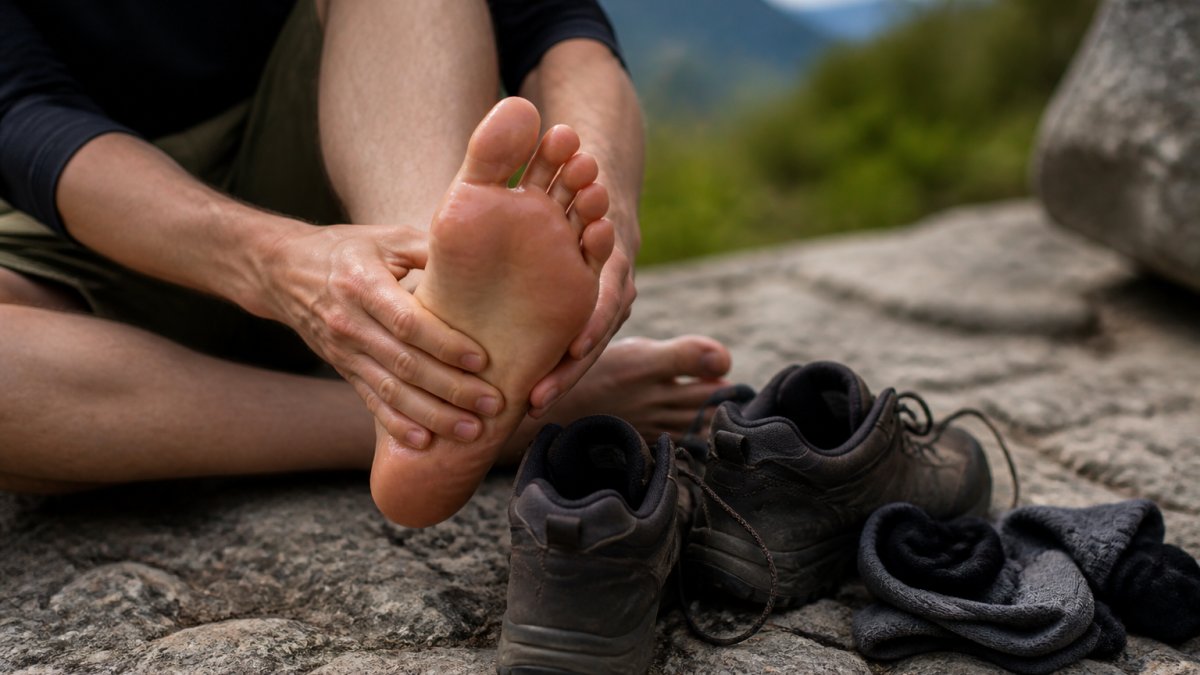
If you've peeled off a boot after a climb and found your sock wringing wet, you know why do my feet sweat so much in hiking boots. Boots trap heat, block airflow, and hold moisture against skin already producing sweat at a high rate.
Every foot carries roughly 250,000 sweat glands, more per square centimeter than almost anywhere else on the body. They respond to heat and exertion the same way: by producing moisture.
Heat, Effort, and the Sweat Glands That Never Switch Off
Your feet sit inside an insulated shell, generate friction with every step, and carry your body weight plus a pack. Boots that protect against rocks and weather also block the ventilation that would let moisture escape, so on a long hike the inside of your boot becomes a humid chamber.
The American Academy of Orthopaedic Surgeons guidance on foot care notes that moisture softens skin and increases friction damage, which is why damp feet blister faster than dry ones. Sweat itself isn't the enemy. Sweat that can't escape is.
Breathable Hiking Boots vs Waterproof: The Trade-Off That Soaks Your Socks
Waterproof boots keep water out and keep sweat in.
A waterproof membrane is a thin barrier engineered to stop liquid water while allowing some vapor to escape.
A non-waterproof boot with mesh panels has far less resistance to vapor escape, and far less resistance to liquid water.
Use this decision guide, and read the reasoning column rather than just the recommendation:
| Condition | Better Choice | Why |
|---|---|---|
| Hot, dry, high-effort climbs | Breathable, non-waterproof | Ventilation beats protection when there's no water to block, and internal heat is the dominant problem |
| Wet, cold, shoulder-season | Waterproof | Dry from outside matters more than vapor escape, and cold wet feet lose heat fast |
| Mixed conditions, long days | Waterproof with moisture-wicking socks | You'll need the sock layer to compensate for reduced vapor escape |
| Creek crossings and rain | Waterproof | Trapped sweat is manageable; soaked boots are not |
| Multi-day trips with limited drying time | Breathable if forecast is dry; waterproof if not | Boots that stay damp overnight compound the problem the next morning |
Two factors most buyers ignore:
- Hike duration. A two-hour day hike gives sweat little time to accumulate, so a waterproof boot's reduced breathability matters less. An eight-hour climb in summer heat is where the membrane penalty shows up.
- Terrain and water exposure. Desert and alpine rock routes rarely soak boots from outside. Boggy trails, talus fields after rain, and creek-heavy routes do. Match the boot to the water you'll actually encounter, not the water you fear.
The mistake is buying waterproof boots for summer desert or alpine climbing and blaming your socks for the swamp.
Boot Fit, Insoles, and Ventilation: The Overlooked Causes of Foot Sweating
Fit contributes to foot sweating more than most hikers realize. A boot that's too tight compresses the foot, reduces circulation, and eliminates the air gap that lets moisture move away from skin. Too loose causes excess sliding, friction, heat, and more sweat.
Three overlooked contributors:
- Insoles: Original insoles are often dense foam that holds moisture. A breathable or moisture-managing insole changes how much sweat stays against your sole.
- Lacing and volume: Over-lacing the midfoot traps heat. Adjust lacing at rest stops as your feet swell.
- Ventilation features: Mesh panels, drainage ports, and open tongue designs matter. A fully sealed boot has no exhaust.
How to Prevent Blisters Trail Running When Your Feet Are Already Wet
Blisters form when moisture, friction, and heat combine: wet skin softens, soft skin tears, and the shear forces of technical terrain do the rest. To prevent blisters trail running, accept that you cannot keep feet perfectly dry, you can only manage moisture and reduce friction.

The sequence that works:
- Start with dry feet and dry socks. Never begin a run in yesterday's damp pair.
- Use a moisture-wicking liner or sock that moves sweat away from skin rather than holding it.
- Address hot spots immediately. Stop and treat a hot spot the moment you feel it. Micro-blisters become full blisters in minutes on descents.
- Change socks mid-run on anything long enough to soak through.
- Reduce debris intrusion. Grit inside the shoe acts like sandpaper against wet skin.
That last point is where our RockResist GEN1 Trail Running Socks do their job. The integrated barrier at the collar helps block dirt, sand, and small trail debris from entering, and the added heel material helps reduce friction at the collar.
Finding the Best Moisture-Wicking Hiking Socks for Hot Conditions
The best moisture-wicking hiking socks for hot conditions use fibers that transport sweat away from skin and dry quickly, plus a fit that stays put without bunching. Construction and fit decide whether the sock performs on a long climb.
What to look for:
- Fiber blend that moves moisture rather than absorbing and holding it
- Reinforced seams where abrasion is highest, especially the heel and toe
- A secure, non-slip fit so the sock doesn't shift and create friction
Merino Wool, Liner Socks, and Why Material Matters
Merino wool manages moisture, resists odor, and regulates temperature; the trade-offs are cost, durability under heavy abrasion, and slower drying than some synthetics.
A practical material comparison for hot-weather hiking:
RockResist Trail Running Sock Bundle, 3 Pairs →
| Material | Moisture behavior | Drying speed | Durability | Best use |
|---|---|---|---|---|
| Merino wool | Absorbs and buffers vapor, resists odor | Moderate | Moderate under abrasion | Cool to mild conditions, multi-day trips where odor matters |
| Synthetic (polyester, nylon, olefin) | Wicks and spreads moisture, dries fast | Fast | High | Hot conditions, high-sweat hikes, daily rotation |
| Cotton | Absorbs and holds moisture against skin | Slow | Moderate | Not recommended for hiking; holds sweat and promotes blisters |
| Blends | Balances wicking with durability and cost | Varies | Varies | General hiking when the blend is engineered for moisture transport |
A thin synthetic liner under a wool or blended outer sock reduces shear at the skin, which is why some hikers use them on long descents.
Our own socks use a 75% cotton and 25% terylene blend with a debris-blocking cuff. If you want a fresh pair ready while another dries, the 3-pair bundle runs $67.50, and it's built for exactly that rotation.

A Step-by-Step Sweat Management Routine for Long Hikes
Sweat management is a routine, not a product. Hikers who finish long days with intact feet follow a sequence before, during, and after the hike, and treat sock changes as part of the plan rather than an emergency measure.
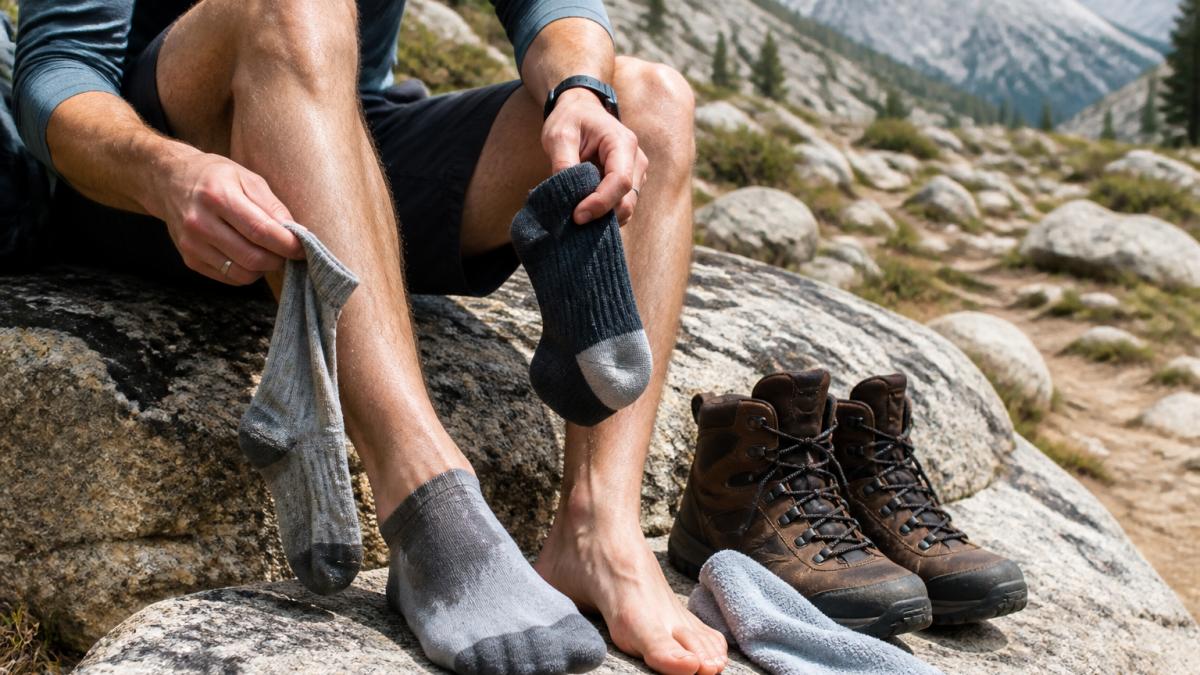
Here's the routine we'd run on any long hike:
- Pre-hike: Apply a foot antiperspirant the night before and again in the morning. Antiperspirant spray or cream reduces sweat output at the skin, not just the smell.
- Trailhead: Start with dry feet, dry socks, and boots that have fully dried since the last outing.
- First hour: Adjust lacing before you feel pressure. Don't wait for a hot spot.
- Every 2-3 hours: Air your feet for a few minutes. Remove socks, wipe feet dry, let boots vent.
- Mid-hike: Swap to dry socks on any hike long enough to soak through. This is the single highest-impact habit.
- Post-hike: Remove insoles, loosen laces, and let boots dry completely with airflow. Never store them sealed and damp.
Sock Changes, Boot Drying, and Antiperspirant That Actually Works
Sock changes reset the moisture level at the skin. Carry one extra pair minimum on any long hike, two on multi-day trips. Wet boots guarantee wet feet within minutes the next day: stuff them with dry material overnight, pull insoles out, and keep them out of a sealed pack.
Foot antiperspirant is the most underused tool in this routine. Applied consistently, it reduces sweat production at the source, changing how quickly your socks saturate. Look for products formulated for feet rather than general underarm products.
When Sweaty Feet Are More Than Just Sweaty Feet
Excessive sweating has a clinical name: hyperhidrosis. It's worth understanding the difference between normal exercise sweating and a condition that warrants a conversation with a clinician.
Normal activity sweating is proportional to heat and effort and stops when you cool down. Hyperhidrosis involves sweating that exceeds what the situation calls for, often at rest, in cool conditions, or in response to emotional stress.
Signs worth flagging to a healthcare professional:
- Sweating through socks and shoes while at rest or in cool temperatures
- Episodes triggered by anxiety or emotional stress rather than heat
- Skin maceration, persistent irritation, or recurring fungal growth between toes
The International Hyperhidrosis Society overview of excessive sweating documents that the condition is common and treatable, with options ranging from clinical-strength antiperspirants to medical interventions. The MedlinePlus resource on hyperhidrosis from the National Library of Medicine is a useful starting point for understanding treatment categories.
None of this is a diagnosis, and it isn't meant to be.
Conclusion
Managing sweat in hiking boots comes down to understanding the trap, matching footwear to conditions, and running a routine that resets moisture before it causes damage. The hikers who struggle most never change socks and never let their boots dry.
At RockResist, we build socks for the conditions that cause this problem: debris-blocking cuffs to keep grit off damp skin, moisture-management fibers, reinforced seams, and a secure fit tested on Colorado trails. Our GEN1 Trail Running Socks are $30 a pair with a second pair free, and the 3-pair bundle at $67.50 gives you the rotation a real sweat-management routine requires.
Add to cart and give your feet a dry pair to change into.
Frequently Asked Questions
Why do waterproof hiking boots make my feet sweat more?
Waterproof membranes block water from getting in, and they block vapor from getting out. Your feet produce sweat continuously during physical activity, and in a waterproof boot that moisture has nowhere to go. It condenses on the inside of the liner, so your socks stay damp even though nothing leaked in. Breathable boots trade some weather protection for airflow, which is why the right choice depends on conditions. On dry, hot trails, a non-waterproof boot with good ventilation usually keeps feet drier than a waterproof one.
Can I use antiperspirant on my feet before a hike?
Yes. A foot antiperspirant containing aluminum chloride or aluminum chlorohydrate reduces sweat at the gland. Apply it to clean, completely dry feet the night before, not the morning of, because it needs time to plug the ducts and morning application tends to wash off. Skip broken skin, blisters, or raw spots. A spray formulation reaches between the toes more easily than a stick. Pair it with moisture-wicking socks and a sock change on long hikes, and most people notice a real drop in dampness within a few outings.
How often should I change my socks while hiking?
On a long hike in hot conditions, plan on a fresh pair every 3 to 4 hours, or roughly every 8 to 10 miles. Carry the dry pair in a sealed bag so it does not absorb moisture from the rest of your pack. Swap socks at a break rather than waiting for a problem, and let the damp pair hang from your pack to dry. Rotating socks is the single most effective habit for keeping skin moisture down, because no sock material wicks indefinitely once it is saturated.
How do I know if my sweaty feet are hyperhidrosis or just normal sweating?
Normal exercise sweating stops when you cool down and dry off. Hyperhidrosis is excessive sweating that happens without heat or effort, often soaking through socks and shoes while you sit still, and it usually affects both feet symmetrically. It commonly starts in childhood or adolescence and can be triggered by anxiety or emotional stress. If your feet sweat heavily at rest, stain footwear, or cause repeated fungal growth and odor, that pattern is worth raising with a clinician rather than troubleshooting boots alone.