

Table of Contents
- Durability and Race-Day Reliability in Ultramarathons
- How Gear Failure Derails Ultra Performance
- Preventing Debris in Running Shoes During Long-Distance Events
- How to Prevent Blisters During an Ultramarathon
- Weight-to-Durability Trade-offs in Technical Fabrics
- Cost-Per-Mile Analysis: Why Durable Gear Saves Money
- Durability Testing Protocols for Extreme Conditions
- Frequently Asked Questions
Last Updated: September 19, 2026
Durability and Race-Day Reliability in Ultramarathons
Why durability matters for ultra marathon gear comes down to one fundamental truth: when you're 50 miles into a 100-mile race and your gear fails, there's no pit crew to hand you replacements. The structural integrity of every piece of equipment you wear directly determines whether you finish strong or limp to the finish line.
Ultramarathons demand more from gear than any other endurance sport. While a road marathon stresses equipment for 3-4 hours, an ultramarathon demands 12, 24, or even 48 hours of continuous performance (2025 U.S. National 24 Hour Qualification Standards and List of Current Qualifiers). This extended duration exposes every weak point: seams separate under sustained load, moisture-wicking fabrics become saturated, and protective barriers lose effectiveness as they accumulate wear.
At RockResist, we've tested gear across some of the toughest terrain in the country. What we've learned is that durability isn't luxury, it's the foundation of race-day reliability. When your socks stay intact, when your apparel maintains its moisture-wicking properties, when seams don't fail under repetitive stress, you can focus on pacing, strategy, and pushing your limits. Without durability, you're fighting your gear instead of the course.
The difference between finishing and DNF'ing often comes down to small failures that compound over hours. A blister starting at mile 30 becomes unbearable by mile 60. Debris entering your shoe at mile 20 worsens with every step. Seams beginning to separate at mile 40 completely fail by mile 70. These aren't dramatic catastrophes, they're the slow accumulation of gear failure.
How Gear Failure Derails Ultra Performance
Gear failure in ultramarathons doesn't announce itself dramatically. A small seam tear becomes larger. Moisture-wicking fabric loses integrity. A compromised barrier lets debris slip through.
The most common failure point is the shoe collar area, where debris naturally enters and repetitive friction creates stress. After 30 miles, the collar has flexed thousands of times. If the sock's structural integrity is compromised, seams aren't reinforced, or the debris barrier isn't engineered for extended wear, failure begins here.
Weight-to-durability ratio is critical in ultramarathons because every ounce matters over 50+ miles. The best ultra gear balances lightness with durability: lightweight enough to not burden your legs, but durable enough to withstand extended racing stress.
Moisture management compounds gear failure. When fabric loses its ability to wick sweat, your feet stay wet, develop blisters faster, and experience more friction. A sock that maintains moisture-wicking properties throughout an ultramarathon prevents this cascade.
Preventing Debris in Running Shoes During Long-Distance Events
Debris in your shoes is one of the most insidious problems in ultramarathon running. A single grain of sand or small pebble might seem insignificant, but after 50 miles of repetitive friction, it becomes a source of blistering and pain that can derail your entire race.
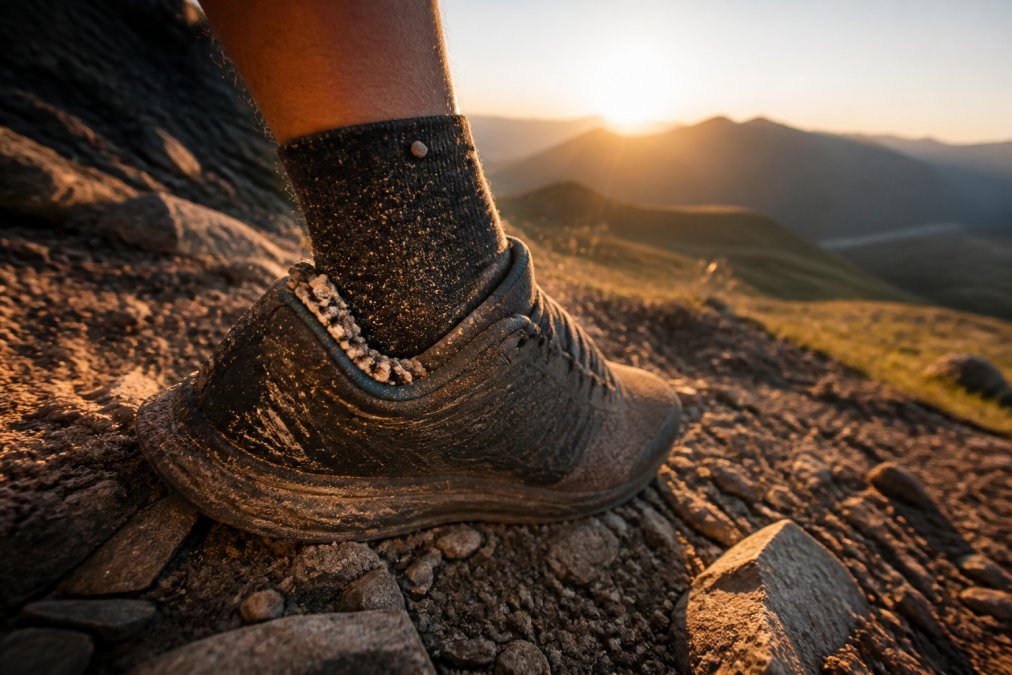
The most effective approach to preventing debris is multi-layered. First, choose socks with an integrated barrier at the shoe collar, the primary entry point for dirt and small rocks. This barrier should sit high enough to block debris without restricting ankle movement. The RockResist Trail Running Sock Bundle includes an integrated barrier engineered to block dirt, sand, and small trail debris while maintaining a secure, non-slip fit.

Second, barrier placement matters. A loose barrier allows debris to slide past it. Reinforced construction keeps the barrier tight and in position, preventing this vulnerability.
Third, debris prevention is a wear-and-tear issue. The barrier experiences friction from your shoe collar, leg movement, and debris itself. Durable technical fabrics with reinforced seams maintain effectiveness throughout an ultramarathon; cheaper materials degrade and lose their seal.
Some ultramarathon courses feature loose terrain early and technical rock later. Wearing your barrier up for loose terrain and tucking it in during technical sections allows you to adapt to changing conditions, giving you the best chance of keeping debris out throughout your race.
How to Prevent Blisters During an Ultramarathon
Blisters are the silent race-killer of ultramarathons. They don't appear suddenly at mile 80, they develop gradually from mile 5 onward, and by the time you notice them, they've already compromised your ability to run efficiently.
Blister prevention depends on three factors: moisture management, friction reduction, and consistent sock integrity. A sock excelling in one area but failing in another will still cause blisters.
Moisture management is foundational. Dry feet resist blister formation; wet feet soften and become vulnerable to friction damage. Technical fabrics that wick moisture away from your skin are essential. Cotton absorbs and holds moisture; synthetic blends and technical fibers move it away. This difference becomes critical after 20+ miles.
Friction reduction requires a secure fit without slipping and added material in high-friction zones. The heel is the primary friction point. Extra cushioning in the heel area reduces repetitive friction that causes blisters. A slipping sock creates additional friction with every stride, compounding over 50+ miles. Secure, non-slip construction prevents this.
RockResist Trail Running Sock Bundle, 3 →
Sock integrity throughout the race matters more than initial comfort. A sock that feels great at the start but loses structure after 30 miles will cause blisters in the final miles. Reinforced seams, durable technical fabrics, and quality construction ensure the sock at mile 90 is as effective as at mile 10.
Weight-to-Durability Trade-offs in Technical Fabrics
The tension between weight and durability defines gear selection for ultramarathon runners. Lighter gear reduces cumulative fatigue; carrying an extra ounce for 100 miles means moving an additional 100 ounces total. But lighter materials often sacrifice durability.
Technical fabrics engineered for ultramarathon performance maximize durability per ounce. A 75% cotton and 25% terylene blend is used in RockResist GEN1 low-cut performance socks.

Abrasion resistance is critical. A lightweight fabric that tears easily is worthless in an ultramarathon. Quality ultra gear resists abrasion from rock contact, shoe collar rubbing, and constant friction over 50+ miles through fiber structure and material composition, not added weight.
Seam quality is where weight-conscious manufacturers cut corners. A fully reinforced seam adds minimal weight but dramatically increases durability. A single-stitched seam saves grams but fails under ultramarathon stress. Quality ultra gear uses reinforced seams throughout.
The real trade-off isn't between weight and durability, it's between cheap materials and engineered solutions. Properly designed technical fabrics achieve both lightness and durability through intelligent material selection and construction methods, not by choosing one at the expense of the other.
Cost-Per-Mile Analysis: Why Durable Gear Saves Money
Durability directly impacts the cost-per-mile of your gear. A sock that costs more upfront but lasts through multiple ultramarathons delivers better value than a cheaper sock that fails after one or two races.
Consider the math: the RockResist Trail Running Sock Bundle costs $58.48 for three pairs, which is approximately $19.49 per pair.
But cost-per-mile calculation goes deeper than simple math. A sock that fails mid-race forces you to either finish in compromised conditions or DNF entirely. The cost of a DNF isn't just the entry fee, it's the training time, travel expenses, and lost opportunity. A durable sock that gets you to the finish line has value that extends far beyond its purchase price.
Durability also matters for training. The same socks you race in should be the socks you train in. Quality training gear allows you to identify potential issues before race day. If your socks are going to fail, you want to discover this during a 20-mile training run, not during mile 60 of your 100-miler. This means you need socks durable enough to handle both training volume and race-day stress.
Many ultramarathon runners build a rotation of 3-4 pairs of race-day socks. This allows adequate rest and recovery for each pair between races while ensuring you always have backup options. A durable sock that lasts 5+ ultramarathons makes this rotation economical. A cheap sock that lasts 1-2 races requires constantly replacing worn-out gear.
Durability Testing Protocols for Extreme Conditions
Understanding how gear durability is tested helps you evaluate products beyond marketing claims. Real durability testing simulates the specific stresses your gear will face in ultramarathons.
Abrasion testing measures how well fabric resists wear from repetitive friction (D4966 Standard Test Method for Abrasion Resistance of Textile Fabrics (Martindale...). Equipment is rubbed against surfaces similar to rock, dirt, and shoe collars under controlled conditions.
Frequently Asked Questions
What are the most common gear failures during an ultramarathon?
Seam separation, moisture saturation, and loss of structural integrity are the leading causes of gear failure in ultra events. When durability is compromised, socks develop holes, compression garments lose elasticity, and moisture management fails, all of which accelerate fatigue and increase blister risk. Durable gear with reinforced seams and technical fabrics maintains integrity across 50+ miles of extreme conditions.
How does gear durability impact blister prevention?
Durable socks maintain their cushioning, seam integrity, and moisture-wicking performance throughout the race. Worn-out socks with thin spots, loose seams, or degraded materials create friction points and allow sweat to pool, both of which trigger blisters. Reinforced heel material and secure construction in durable gear reduce friction at pressure points, keeping your feet blister-free when it matters most.
Is spending more on durable ultramarathon gear worth the cost?
Yes, when measured by cost-per-mile. A $25.99 pair of RockResist GEN1 socks offers durable performance. Over a season of training and racing, durable gear can reduce the need for frequent replacements and minimize injury risk from gear-related failures.
Why is moisture-wicking fabric essential for long-distance trail running?
In ultramarathons, sweat accumulation causes blisters, cold-weather hypothermia risk, and accelerated material degradation. Moisture-wicking fabrics pull sweat away from skin and dry quickly, maintaining comfort and foot health over many hours. Technical fabrics with proven moisture management also preserve the structural integrity of the gear itself, preventing the material breakdown that leads to early failure.