
Table of Contents
- What Makes Fabric Rip Resistant
- Nylon: The Rugged Workhorse
- Polyester: Lightweight and Versatile
- Ripstop Nylon vs Polyester Durability
- Best Synthetic Alternatives to Cotton Athletic Wear
- Merino Wool and Natural Performance Fibers
- How to Choose the Right Material for Your Needs
- Frequently Asked Questions
Last Updated: September 19, 2026
What Makes Fabric Rip Resistant
Rip resistance depends on fiber composition and weave structure, not just thickness. Understanding the 5 best materials for rip resistant outdoor clothing shows that lightweight fabrics can withstand serious abuse if engineered correctly.
Three factors determine rip resistance: fiber strength, weave density, and material flexibility. High tensile strength, tight weaves that distribute force, and materials that flex without breaking all improve durability under the constant tension and abrasion of technical terrain.
Ripstop weave uses thicker reinforcement threads at intervals to create a grid pattern that stops small tears from spreading. Without ripstop, a small tear can run across an entire garment in seconds.
Natural fibers like merino wool offer inherent elasticity, while synthetics like nylon and polyester resist UV degradation and moisture damage. The best materials for rip resistant outdoor clothing combine fiber strength with smart weave engineering.
Nylon: The Rugged Workhorse
Nylon dominates outdoor gear because it delivers durability at reasonable cost, with tensile strength rivaling much heavier materials.
Nylon's molecular structure provides natural resilience, it stretches and bounces back without permanent deformation, absorbing impact and flexing with your body without tearing.
Nylon resists abrasion exceptionally well because rock, branches, and rough terrain can't easily break down its polymer chains. This is why climbers and technical athletes trust nylon where cotton would shred.
Nylon's main weakness is UV degradation, direct sunlight breaks down its polymer structure over time. DWR coatings add UV protection to outdoor nylon garments.
Polyester: Lightweight and Versatile
Polyester offers superior UV resistance, holding its strength and color after months of intense sun exposure, ideal for high-altitude or desert training.
Polyester's tensile strength is slightly lower than nylon's, but it compensates with superior moisture management. The fiber resists moisture absorption, dries faster, and maintains structural integrity when wet, critical for trail runners and climbers.
Polyester's tighter weave density compensates for lower tensile strength, allowing well-engineered polyester garments to match nylon's tear resistance while weighing less and drying faster.
Polyester retains color better than nylon through repeated washing and sun exposure, making it better for visibility on technical terrain.
Ripstop Nylon vs Polyester Durability
Ripstop nylon stops tears by using reinforcement threads to create a grid that prevents small rips from propagating. Most serious climbing pants use ripstop nylon because the weave density and thread spacing catch tears before they become catastrophic failures.
Tear Strength (Elmendorf Tear Test). Standard nylon achieves 4-6 pounds of tear strength, while ripstop nylon reaches 8-12 pounds or higher. A 600-denier ripstop nylon typically outperforms 300-denier standard nylon by 40-60% because reinforcement threads interrupt the tear path and distribute force across a wider area.
Abrasion Resistance (Martindale Test). High-performance ripstop nylon survives 50,000-100,000 cycles before significant degradation, while standard polyester reaches 30,000-60,000 cycles. The ripstop grid's reinforcement threads add structural redundancy, distributing load to adjacent areas as wear occurs.
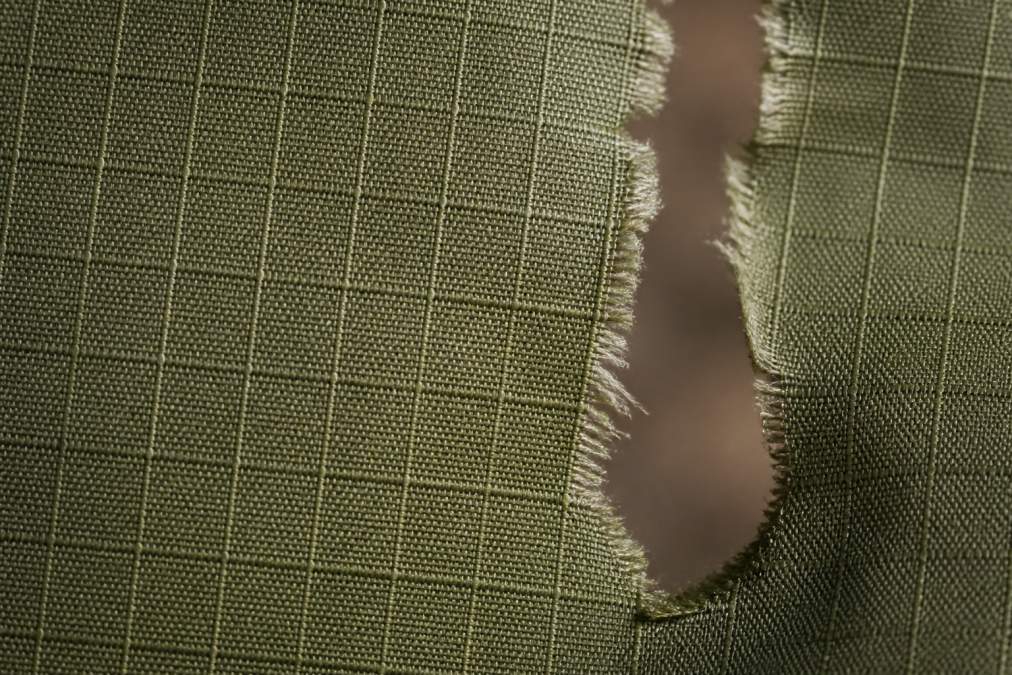
Ripstop polyester achieves tear strength comparable to ripstop nylon (8-12 pounds) but maintains it longer under UV exposure. After 500 hours of accelerated UV testing, ripstop nylon loses 15-25% of tear strength while ripstop polyester loses only 5-10%, making it ideal for runners and hikers in sun-exposed terrain.
Choose ripstop nylon if sharp rock is your main concern and you replace gear annually. Choose ripstop polyester if you expect gear to last multiple seasons in high-UV environments. Both use reinforcement threads to interrupt tear propagation; the choice reflects whether you prioritize raw durability (nylon) or durability retention over time (polyester).
Best Synthetic Alternatives to Cotton Athletic Wear
Cotton fails in serious outdoor conditions. The fiber absorbs moisture, loses tensile strength when wet, and dries slowly. For athletes training in harsh terrain, cotton is a liability. But the shift from cotton to synthetics introduces trade-offs that most guides ignore: durability versus environmental impact, and maintenance requirements that affect long-term performance.
Nylon and polyester solve cotton's core problems through different mechanisms. Nylon excels at abrasion resistance and elasticity. Polyester excels at moisture management and UV stability. Both are hydrophobic, meaning they repel water instead of absorbing it. This fundamental property keeps them functional when wet, unlike cotton. A cotton shirt loses 20-30% of its tensile strength when saturated with water. Nylon and polyester retain 90%+ of their strength when wet, which is why they dominate technical outdoor wear.
However, synthetic durability comes with a hidden cost: microplastic shedding. Every time you wash a synthetic garment, it releases microplastics into wastewater. A single polyester shirt can shed 124-308 milligrams of microplastics per wash cycle, depending on fabric construction and wash intensity. Over a garment's 50-100 wash cycles, that accumulates to 6-30 grams of microplastics per garment entering aquatic ecosystems. This is the durability paradox: the very properties that make synthetics last longer (tight weaves, high denier, chemical treatments) also make them shed more aggressively.
Maintenance directly affects both durability and shedding. Washing synthetic gear in cold water with gentle detergent reduces microplastic release by 30-40% compared to hot-water washing. Air-drying instead of machine-drying extends garment life by 20-30% and eliminates the additional shedding that tumble-drying causes. A ripstop nylon climbing pant that receives proper care (cold water, gentle cycle, air dry) can last 3-5 years of heavy use. The same garment machine-washed in hot water and dried hot will degrade noticeably in 1-2 years and shed significantly more microplastics in the process.
DWR (durable water-repellent) coatings add another layer of complexity. Most outdoor synthetics use fluorocarbon-based DWR treatments (PFOA or PFAS compounds) to repel water and enhance durability. These treatments improve performance but persist in the environment indefinitely and accumulate in human tissue. Fluorine-free DWR alternatives exist but are less durable and require more frequent reapplication. The trade-off is real: maximum durability requires chemical treatments with environmental persistence.
For trail runners and climbers, the practical choice remains synthetic materials because the performance gap versus cotton is too large to ignore. But informed athletes should understand the maintenance requirements that preserve durability and minimize environmental impact:
- Wash in cold water with minimal detergent to reduce microplastic shedding and preserve DWR coatings
- Air-dry completely rather than machine-drying to extend garment life and avoid additional shedding
- Reapply DWR treatments annually (or every 6 months for high-use gear) to maintain water repellency and reduce the need for replacement
- Patch small tears immediately to prevent them from spreading and forcing premature replacement
- Consider microfiber-catching washing bags that capture shed fibers before they enter wastewater
Merino wool offers a middle ground: it's a natural fiber that performs like a synthetic in abrasion and moisture management, and it sheds biodegradable fibers rather than persistent microplastics.
Merino Wool and Natural Performance Fibers
Merino wool occupies a unique position. It's a natural fiber that performs like a synthetic in several critical ways. The fiber has natural crimp and elasticity that gives it tear resistance comparable to nylon. Merino also manages moisture in a way cotton never could: it absorbs moisture vapor without feeling wet, then releases it when conditions change.
How to Choose the Right Material for Your Needs
Start with your primary threat. What will damage your gear most?
| Material | Best For | Primary Advantage | Trade-off |
|---|---|---|---|
| Ripstop Nylon | Rock climbing, bouldering | Exceptional tear resistance, abrasion protection | Fades in UV exposure |
| Ripstop Polyester | Trail running, hiking | UV stability, quick-dry | Slightly lower tensile strength |
| Merino Wool | Cool-weather training | Natural moisture management, comfort | Higher cost, requires care |
| Standard Nylon | General outdoor use | Durable, affordable | Less tear-resistant than ripstop |
| Standard Polyester | Sunny environments | Color retention, UV resistance | Not ideal for high-abrasion activities |
Frequently Asked Questions
What is the most durable fabric for outdoor clothing?
Ripstop nylon and high-denier polyester are the most durable fabrics for outdoor clothing. Ripstop weaves use reinforced grid patterns that stop tears from spreading, while high-denier materials have greater tensile strength and abrasion resistance. The best choice depends on your activity: ripstop excels on sharp rock or jagged terrain, while polyester handles UV exposure and moisture better. For serious outdoor athletes, materials combining ripstop technology with moisture-wicking properties deliver the best balance of durability and performance.
Is ripstop nylon actually rip-resistant?
Yes, ripstop nylon is genuinely rip-resistant due to its specialized weave structure. The fabric uses thicker nylon filaments woven in a grid pattern that interrupts tear propagation, preventing small rips from becoming large ones. When a tear occurs, it stops at the reinforced grid lines rather than spreading across the entire fabric. This tensile strength advantage makes ripstop nylon ideal for climbers and trail runners who encounter sharp objects. However, the material can still be punctured or torn if the force is concentrated enough, so ripstop is resistance-enhancing rather than tear-proof.
How do I choose between polyester and nylon for outdoor gear?
Choose nylon if you prioritize tear resistance and durability against abrasion on rough terrain. Nylon has superior tensile strength and handles contact with sharp rock better. Choose polyester if you need lightweight gear with excellent UV resistance and quick-dry properties. Polyester resists color fading and moisture absorption better, making it ideal for long-distance hiking and water-exposed activities. For maximum protection, look for ripstop nylon with moisture-wicking treatments, or polyester blends that combine quick-dry benefits with enhanced abrasion resistance.
What makes a fabric tear-resistant?
Tear resistance depends on three factors: denier (fiber thickness), tensile strength (how much force the fiber withstands), and weave density (how tightly fibers are interlocked). Higher-denier fabrics have thicker filaments that resist puncture and tearing. Ripstop weaves add reinforced grid patterns that prevent tears from spreading. Hydrophobic or DWR coatings protect fibers from moisture damage that weakens tensile properties. Materials engineered for high tensile stress, like reinforced nylon or technical polyester, maintain fiber integrity under pressure and abrasion, which is critical for outdoor gear exposed to sharp terrain.