
Table of Contents
- Why Standard Merino Wool Socks Overheat in Summer
- What Makes a Smartwool Alternative for Hot Weather Work
- Synthetic vs Merino Wool Socks for Hiking: The Real Trade-Offs
- RockResist GEN1 Socks: Built for Heat and Debris
- How to Prevent Blisters in Hot Weather: Material Matters
- Care and Maintenance for Summer Performance Socks
- Final Verdict: Choose the Right Hot Weather Sock
- Frequently Asked Questions
Last Updated: September 7, 2026
Most runners and hikers default to merino wool when the mercury climbs, assuming natural fibers are always the answer for temperature control. That assumption breaks down in real summer heat, where the same insulation that regulates winter warmth traps body heat and holds moisture against your skin. Finding a true Smartwool alternative for hot weather requires understanding why fabric logic shifts above 80 degrees.
At RockResist, we engineer gear for rugged Colorado trails where summer conditions punish equipment choices. This guide breaks down the material science and why a debris-blocking sock built for heat outperforms traditional wool on dusty trails.
Why Standard Merino Wool Socks Overheat in Summer
Merino wool excels as an insulator, which is precisely the problem in hot weather. The same fiber structure that traps warm air against your skin in winter creates a stagnant heat layer in summer, preventing the airflow your feet need for cooling.
The physics come down to fiber diameter and moisture regain. Fine merino fibers, typically under 20 microns, create dense fabric structures that hold more water before feeling wet (peer-reviewed research). This moisture retention slows evaporative cooling, the primary mechanism your body uses to shed heat. American Council on Exercise heat dissipation guide explains that evaporative cooling requires moisture to reach the fabric surface and evaporate quickly, something thick wool knits resist.
Standard merino socks also arrive with a weight problem. Most winter-oriented wool socks fall between 200 and 250 GSM, a density designed for insulation rather than ventilation. In 90-degree heat, that thickness translates directly to trapped heat and accelerated fatigue.
What Makes a Smartwool Alternative for Hot Weather Work
An effective hot-weather sock prioritizes rapid moisture transport, maximum airflow, and minimal insulation, pulling sweat to the surface where it can evaporate rather than absorbing it into the fiber core.
A smartwool alternative built for heat uses hydrophobic synthetic fibers that resist water absorption. This is the critical difference: wool absorbs up to 30% of its weight in moisture before feeling wet, while synthetics wick moisture along the fiber surface. The result is faster drying and continuous evaporative cooling against the skin.
Breathability comes from knit structure, not just fiber choice. Mesh ventilation zones across the top of the foot and ankle allow heat to escape while denser weave protects high-wear areas.
Synthetic vs Merino Wool Socks for Hiking: The Real Trade-Offs
Choosing between synthetic and merino for summer hiking means weighing durability against natural comfort, but the decision becomes clearer when you examine performance mechanisms above 80 degrees.
The Moisture Management Divide
Merino wool is hygroscopic, absorbing up to 30% of its weight in moisture before feeling wet. This buffers sweat in winter, but in summer the trapped moisture slows the evaporation that drives cooling.
Synthetic fibers like polyester and nylon are hydrophobic, forcing moisture along the fiber surface via capillary action. This spreads sweat across a larger area, accelerating evaporation. A synthetic sock dries 2-3 times faster than merino, a difference you feel during rest breaks.
Fiber Blends: The Summer-Specific Sweet Spot
Most top-tier hiking socks are engineered blends, and the ratio matters more than most guides acknowledge. For hot-weather use, the most effective summer-weight blends shift toward synthetics:
- 60-70% synthetic (nylon/polyester) / 20-30% merino: This ratio maximizes wicking and durability while retaining a small amount of merino's natural odor control. The synthetic majority keeps the sock thin, fast-drying, and abrasion-resistant.
- Merino/Tencel blends: Tencel (lyocell) is a wood-pulp fiber that wicks well and feels cool against skin. A 50/50 merino/Tencel blend runs cooler than pure merino but still absorbs more moisture than a synthetic-dominant sock.
- Nylon reinforcement: Look for socks with 15-25% nylon content. Nylon provides the abrasion resistance that pure merino lacks, particularly at the heel and toe where blister-causing friction concentrates.
GSM: The Number That Predicts Heat Retention
Fabric weight, measured in grams per square meter (GSM), is the single most useful number for choosing a summer sock, as it directly determines heat retention.
- 150-180 GSM: True summer weight. These socks feel almost sheer and are appropriate for 85-degree-plus days, road running, and casual hiking.
- 180-220 GSM: Light-to-midweight. Suitable for mild summer mornings or high-elevation trails where temperatures fluctuate. This is the upper limit for comfortable 80-degree wear.
- 220+ GSM: Winter territory. These socks trap heat and should stay in your cold-weather drawer.
A common mistake is buying a "lightweight" merino sock that still comes in at 200 GSM. If the GSM is not listed, that omission is a red flag.
Odor Control: The Honest Assessment
Merino's antimicrobial properties resist odor-causing bacteria, but this advantage is overstated for summer. In hot conditions, no fiber can fully prevent bacterial growth when moisture and warmth persist.
Modern silver-ion or zinc-based antimicrobial finishes survive 50-100 washes, covering a performance sock's lifespan. For day hikes, odor differences are negligible; for multi-day trips where you cannot wash socks, merino retains an edge.
The Durability Reality Check
The durability gap between synthetic and merino is not subtle. Merino fibers are fragile, especially when wet. A wet merino sock on rocky terrain abrades noticeably faster than a dry one, and the thin summer-weight knits that feel great in heat are the most vulnerable. Appalachian Trail Conservancy gear durability guidance notes that synthetic blends consistently outperform natural fibers for long-distance hiking durability.
Nylon has tensile strength roughly 3-4 times that of wool, translating to fewer holes and a longer lifespan. Comparing cost-per-wear, a $20 synthetic sock lasting 500 miles often beats a $25 merino sock wearing through at 200 miles.
The Verdict for Summer
Above 80 degrees, synthetic-dominant blends win on drying speed, durability, and heat management. Merino's odor control and softness are real but secondary when your primary problem is keeping feet cool and dry.
RockResist GEN1 Socks: Built for Heat and Debris
The RockResist GEN1 Road & Trail Low Cut Athletic Socks deliver the synthetic performance advantages while solving a problem wool socks ignore entirely: debris intrusion. A patented polyurethane debris barrier creates a physical shield that prevents dirt, sand, and gravel from entering your shoe during summer trail miles.

The two-configuration design adapts to terrain conditions. Wear the barrier apron up for heavy debris environments like gravel trails and loose scree. Tuck the barrier down inside the sock for a low-profile, no-show appearance during lighter conditions while maintaining heel friction protection.
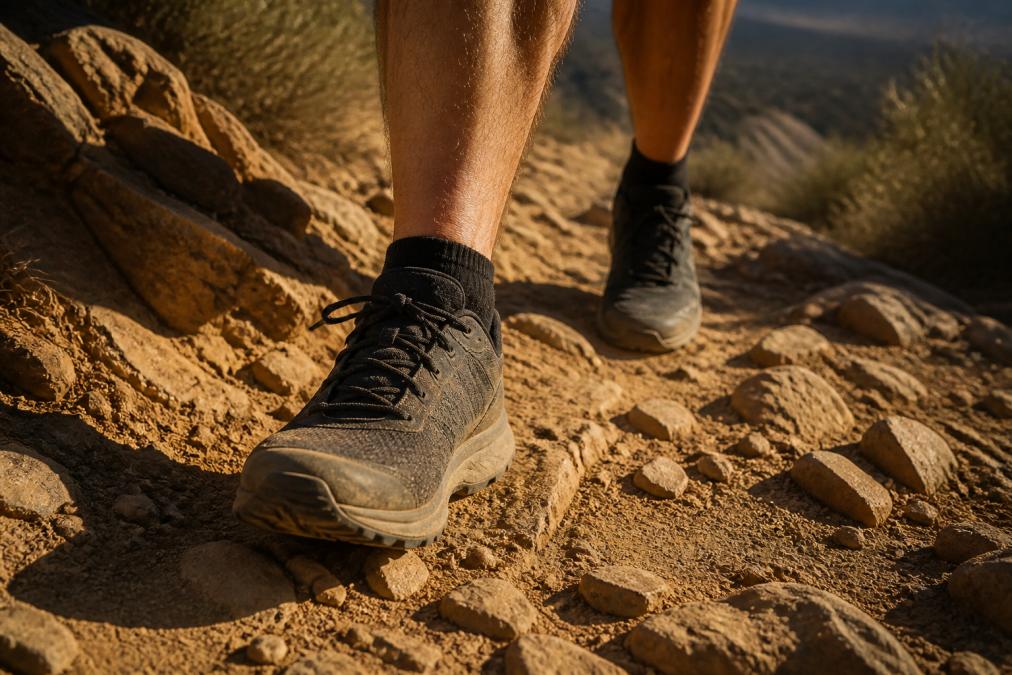
Added heel material reduces friction at the collar, directly addressing one of the primary blister causes in hot weather. At $25.99, the GEN1 sock competes favorably with premium wool options while offering debris protection no merino sock provides.
How to Prevent Blisters in Hot Weather: Material Matters
Blisters form from friction combined with moisture, and summer creates both in abundance. Preventing them requires addressing both factors, but the full summer protection picture extends to a factor most sock guides ignore: UV exposure.
The Friction-Moisture-Debris Cycle
Friction management starts with sock construction. Reinforced seams and smooth knit patterns eliminate rough points, and the GEN1 sock's added heel material buffers between the shoe collar and Achilles tendon.
Moisture control prevents the skin softening that makes blisters inevitable. A sock that wicks sweat and dries quickly maintains the friction balance that prevents hot spots, with synthetic fibers moving moisture to the outer surface for evaporation.
Debris exclusion completes the blister prevention equation. A single grain of sand trapped between sock and foot grinds with every step. The polyurethane barrier on RockResist socks prevents this intrusion at the source.
The Overlooked Factor: UPF Ratings for Feet
Here is the gap in nearly every hot-weather sock guide: none discuss ultraviolet protection. Above tree line, on exposed ridgelines, or across desert terrain, your feet receive direct, sustained UV exposure. The skin on the top of your foot and around the ankle is thin and vulnerable, and repeated exposure compounds over time.
The Ultraviolet Protection Factor (UPF) rating measures how much UV radiation penetrates fabric. A UPF 50 rating blocks approximately 98% of UV rays, while an ordinary white cotton t-shirt provides roughly UPF 5-8.
Fabric factors that influence UPF include:
- Fiber type: Polyester and nylon absorb more UV radiation than cotton or untreated wool. Dense synthetic knits naturally block more UV than loosely woven natural fibers.
- Knit density: Tighter weaves leave fewer gaps for UV penetration. A sock with a dense knit structure provides better protection than a loose mesh, even if the mesh feels cooler.
- Color: Darker colors absorb more UV than light colors. A black or navy sock blocks significantly more UV than a white sock of identical construction.
- Stretch: Fabric that stretches when worn allows more UV through. A sock that fits snugly but not tightly maintains better protection than one stretched thin over a high instep.
What to Look For in a Summer Sock
When selecting a sock for exposed trails, look for a UPF rating. The Skin Cancer Foundation recommends UPF 30 or higher, with UPF 50 the standard for serious sun exposure. If a brand does not publish a rating, estimate based on fiber and color: a dense, dark synthetic sock generally outperforms a light merino sock of similar weight.
The RockResist GEN1 sock's dense knit provides meaningful UV blocking, though the primary focus remains debris protection and moisture management. For maximum sun safety, pair any performance sock with broad-spectrum sunscreen on the tops of your feet and ankles.
Care and Maintenance for Summer Performance Socks
Performance socks last longer with proper care. Machine wash in cold water with mild detergent, then air dry. Skip fabric softener, which coats synthetic fibers and reduces moisture-wicking effectiveness.
Heat damages elastic fibers and accelerates wear. High-temperature washing breaks down synthetic polymers, while dryer heat shrinks and distorts the knit structure. Air drying preserves fit and function.
Rotate between multiple pairs to extend lifespan. A sock left to fully dry between uses resists bacterial growth and maintains structural integrity, giving moisture-management fibers time to recover.
Final Verdict: Choose the Right Hot Weather Sock
The best hot-weather sock depends on your activity and terrain. For casual walks and mild conditions, merino remains comfortable. For trail running, hiking, or any activity involving debris or extended mileage, synthetic performance socks deliver superior moisture management and durability.
| Sock Type | Best For | Key Limitation | Price Range |
|---|---|---|---|
| Merino wool | Cool to mild conditions, casual wear | Traps heat above 80°F, slow drying | $18-$30 |
| Synthetic performance | Trail running, hiking, hot weather | Less natural odor resistance | $15-$26 |
| Hybrid blends | Moderate conditions, mixed terrain | Compromised performance | $20-$35 |
A smartwool alternative engineered for heat must address moisture, friction, and debris. The RockResist GEN1 sock tackles all three with its debris-blocking barrier, moisture-management fibers, and reinforced heel construction, tested across demanding Colorado conditions.
Choosing the right sock for hot weather comes down to understanding how materials behave when temperatures rise and trails turn gritty. RockResist builds performance gear that solves these problems directly, combining debris-shielding technology with moisture-wicking construction tested on rugged terrain. Add the RockResist GEN1 Road & Trail Low Cut Athletic Socks to your kit and keep every summer mile focused on performance, not foot discomfort.
Frequently Asked Questions
What is comparable to Smartwool for summer hiking?
For hot weather, lightweight synthetic socks like the RockResist GEN1 Road & Trail Low Cut Athletic Socks are a strong Smartwool alternative. They manage moisture effectively without the insulation of merino wool. The patented polyurethane debris barrier also blocks dirt and gravel that typically cause blisters on summer trails.
Are synthetic socks better than merino wool for summer?
In high heat, synthetic and synthetic-blend socks often outperform merino wool. They dry faster, manage sweat efficiently, and provide better abrasion resistance against trail debris. Merino wool excels at temperature regulation, but its insulation can trap heat above 80°F. A breathable synthetic blend offers the moisture management summer hiking demands.
Do synthetic socks prevent blisters better than wool?
Blisters form from friction and moisture. Synthetic socks reduce friction through snug fit and smooth fibers, and they wick sweat away faster than wool. The RockResist GEN1 sock adds a polyurethane barrier that stops debris from entering the shoe and reduces heel-collar friction, a primary blister cause. This physical protection provides an advantage over merino in hot, gritty conditions.
What features should I look for in a summer trail sock?
Prioritize a lightweight fabric blend with strong moisture-wicking properties, breathability, and quick-dry performance. Look for reinforced heels and toes for abrasion resistance, plus a snug fit to prevent slipping. For hot weather, consider a sock with a debris-blocking cuff to keep out sand and gravel, which cause friction and blisters on long hikes.