
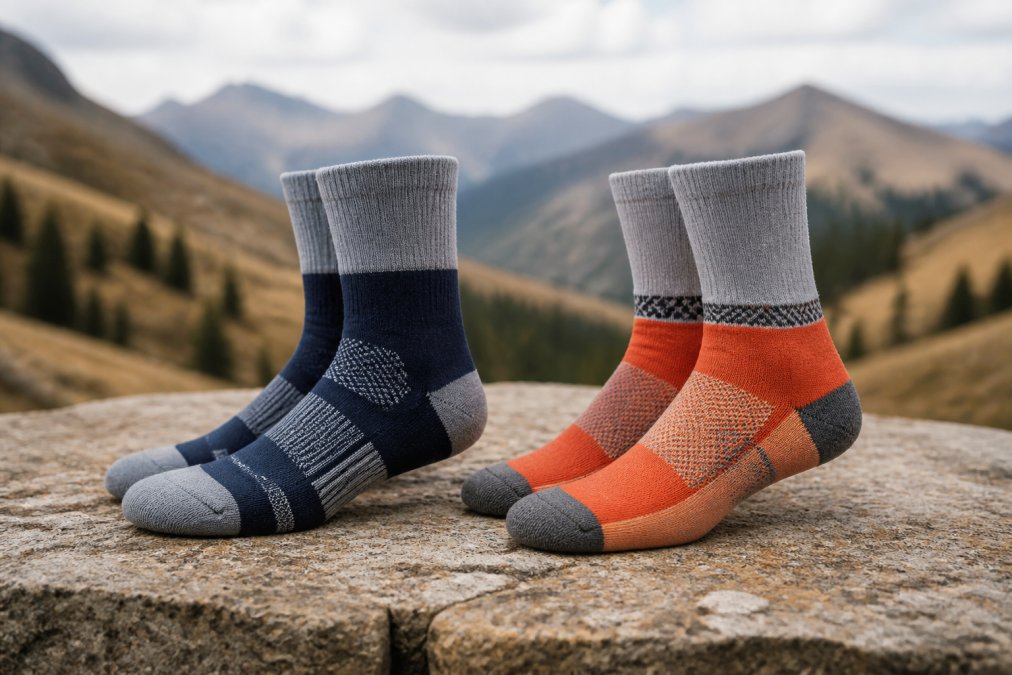
Table of Contents
- Balega vs Performance Trail Socks: The Core Differences
- Best Socks for Trail Running: What Actually Matters on Rugged Terrain
- Synthetic vs Merino Wool Trail Socks: Moisture, Odor, and Durability
- Blister Prevention for Hikers: How Friction Reduction and Moisture Management Work Together
- Sock-to-Shoe Compatibility Matrix: Matching Sock Weight to Footwear
- RockResist GEN1: A Trail-Specific Alternative to Balega
- Conclusion
- Frequently Asked Questions
Last Updated: September 11, 2026
Balega vs Performance Trail Socks: The Core Differences
The gap between a standard cushioned sock and a purpose-built performance trail sock shows up around mile eight, not mile one. Balega built its reputation on plush cushioning and a snug, almost compression-like fit, and for road runners that formula works. On technical terrain, though, cushioning alone doesn't stop grit from entering the shoe or friction from building at the heel collar.
This guide breaks down the construction details that separate the two approaches, then shows what holds up on rock, root, and gravel.
Cushioning Density and Impact Absorption
Cushioning density describes how much material sits between your foot and the midsole, and how firmly it compresses under load. Balega leans toward higher-density plush cushioning in the heel and forefoot, which absorbs impact well on pavement and packed dirt. On uneven rock, thick cushioning reduces ground feel, a problem when you need to read the trail through your feet.
Performance trail socks often use zoned cushioning instead: thicker under the heel and ball, thinner at the arch and instep, keeping impact absorption where you land while preserving proprioception. If your runs are mostly smooth and long, dense cushioning earns its place; on technical terrain, zoned density usually wins.
Fit, Heel Lockdown, and Anatomical Design
Anatomical fit means the sock mirrors the foot's actual shape, with a defined left and right, a contoured heel pocket, and a toe box that matches toe splay. Balega's fit is famously snug, and that snugness is a real advantage: a sock that moves inside the shoe is a sock that rubs.
Heel lockdown is where fit becomes function: a deep heel pocket and elastic arch band hold the sock in place during steep descents, while arch compression adds stability without restricting circulation. Watch for a too-narrow toe box, on long descents, toes push forward, and a tight toe box turns that into black toenails.
Best Socks for Trail Running: What Actually Matters on Rugged Terrain
For trail running, the best socks for trail running prioritize three things over plushness: friction reduction at contact points, debris exclusion at the collar, and moisture movement that continues working after hours of sweat. Cushioning matters, but it's third on that list.
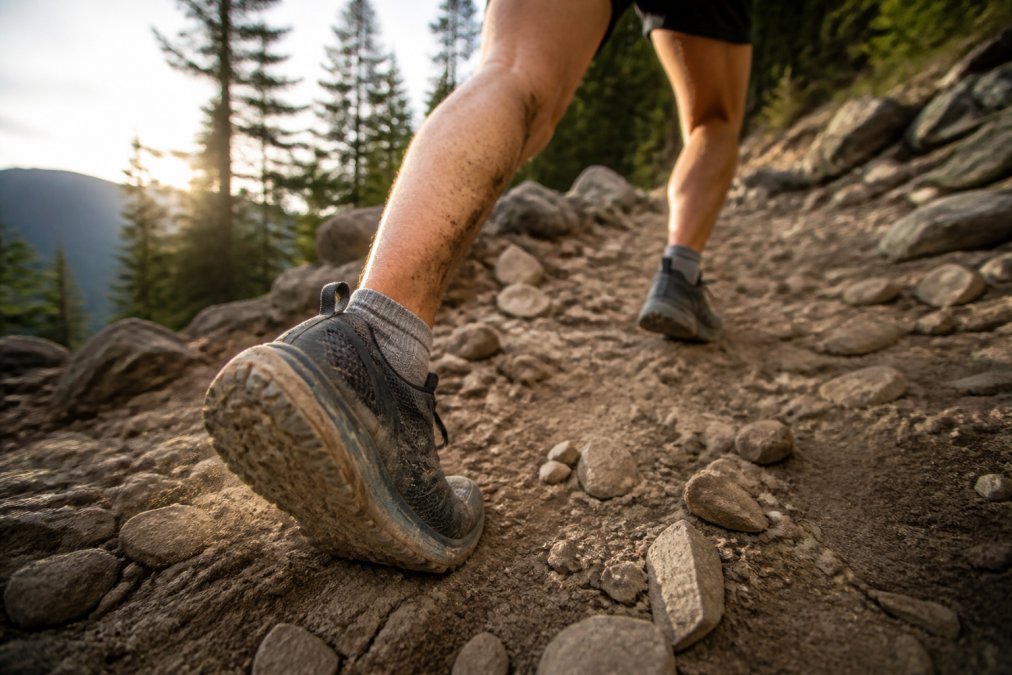
Most buying guides rank socks by cushion height and call it a day. Terrain dictates the requirements, not the reverse.
Terrain-Based Friction Analysis: Rock, Root, and Gravel
Different surfaces generate different friction profiles, and that changes what you need from a sock.
Rock (scree, talus, exposed granite): High point-load friction. Every footfall concentrates force on a small area, sometimes just a few square centimeters under the ball or heel. The sock's job is abrasion resistance and impact distribution. Reinforced heel and toe zones in high-tenacity nylon or aramid-blend yarns outlast plush terry-loop fabric, which compresses flat under repeated point loads.
Root (exposed tree roots, wet clay, forest singletrack): Slick, irregular surfaces force micro-adjustments inside the shoe, so the sock has to stay put. Heel lockdown and arch compression decide this: a deep heel pocket plus a wide elastic arch band stops migration. Without it, the sock bunches under the arch, and every bunch becomes a friction point.
Gravel (forest roads, river bars, loose decomposed granite): Constant low-grade abrasion plus debris intrusion, the terrain that exposes the gap between a road sock and a trail sock. Debris-shielding cuffs and seamless toe construction earn their keep: a seamless toe removes the ridge that gravel-driven friction turns into a hot spot, and a taller collar keeps small stones out on descents.
A common mistake is buying one sock for all three. Runners splitting training between smooth singletrack and scree fields usually benefit from two pairs, a light crew for fast, smooth days and a mid-weight crew with reinforced zones for technical days.
Debris-Shielding Technology and Toe Box Volume
Debris-shielding technology is a physical barrier at the sock's collar that blocks dirt, sand, and small gravel from entering the shoe. A taller cuff reduces debris entry but doesn't eliminate it, since grit still works through the knit; a denser knit or coated barrier creates a physical seal. RockResist's patented polyurethane debris barrier does exactly this, shielding the heel collar while reducing friction at that contact point.
Toe box volume works alongside it. Too tight creates pressure points; too loose and the fabric bunches, its own friction source. The right fit lets toes splay slightly on impact without the fabric folding, on long descents, a tight toe box turns forward toe push into black toenails, a loose one into blisters.
Sock-to-Shoe Compatibility: Matching Sock Weight to Footwear Volume
Matching sock weight to shoe volume prevents the two most common fit failures: cramped toes and heel slippage. Use this matrix before you buy.
| Sock Weight | Best Shoe Type | Terrain | Watch For |
|---|---|---|---|
| Ultra-light no-show | Race-day road shoes | Pavement, track | Heel slip on descents |
| Light crew | Low-volume trail shoes | Smooth singletrack | Debris entry at collar |
| Mid-weight crew | Standard trail runners | Mixed rock and root | Toe crowding |
| Cushioned mid-calf | High-volume hiking boots | Technical, loaded pack | Heat buildup |
Sock weight and shoe volume have to agree. A cushioned sock in a snug race shoe cramps your toes; an ultra-light sock in a roomy boot lets your foot slide. Crew length also matters for trail debris protection, since a taller collar keeps grit out of the shoe on loose descents.
Synthetic vs Merino Wool Trail Socks: Moisture, Odor, and Durability
The synthetic-versus-merino debate usually gets framed as comfort versus performance. That framing is outdated: the real variables are fiber diameter, yarn twist, and blend ratio, which determine how a sock behaves at mile two versus mile twenty.
How Each Fiber Actually Moves Moisture
Merino wool's moisture advantage is often overstated. Wool absorbs roughly 30 percent of its own weight in water vapor before feeling damp, which is why it feels comfortable in light sweat, but once saturated, it holds moisture against the skin and dries slowly (peer-reviewed research). Fine merino fibers (typically 17-19 microns) feel soft but are fragile under abrasion (peer-reviewed research).
Hydrophobic synthetic fibers, polyester, nylon, and polypropylene, don't absorb water at all. They move liquid sweat along the fiber surface to the outer face, where it evaporates: capillary wicking, which is why synthetic socks feel drier during high-sweat efforts. The trade-off is no natural odor resistance, so they need a silver-ion or copper treatment to stay fresh across wears.
The Durability Gap Nobody Measures
Where merino consistently loses is abrasion resistance. Fine wool fibers break down faster than synthetic filaments when rubbed against a shoe liner, insole, or rock, and the high-wear zones, heel, ball, and toe, thin out first.
A common pattern among long-distance runners: a pure-merino sock feels great for the first 200 miles, then starts losing structure. Synthetic blends hold shape and cushioning longer because filament yarns don't fray the same way. That's why most premium trail socks now blend merino near the foot for odor control and thermal regulation, synthetic yarn in the heel and toe for abrasion resistance, and elastane for recovery.
Reading a Fiber Label Like a Buyer, Not a Marketer
The label tells you more than the marketing copy if you know what to look for:
- Merino percentage: Below 40 percent merino, you're mostly getting synthetic performance with a wool price tag. Above 70 percent, expect faster wear in high-friction zones.
- Nylon vs. polyester: Nylon is more abrasion-resistant and usually placed in heel and toe reinforcement. Polyester wicks slightly faster and is common in the main body.
- Elastane (Spandex/Lycra): Typically 2-5 percent, and what gives arch bands and cuffs their recovery. Heat destroys it, which is why wash temperature matters.
- Micron count: Under 20 microns feels soft; over 23 microns feels scratchy. Rarely printed, but it drives the price difference between budget and premium merino.
Matching Fiber to Conditions
For sweat-heavy efforts in warm conditions, hydrophobic synthetic blends win on moisture management and dry faster between runs. For cold-weather hiking where multi-day odor buildup is the concern, merino earns its place, paired with reinforced synthetic zones on technical terrain.
Match the fiber to the conditions, not a brand preference. A 60 percent merino, 35 percent nylon, 5 percent elastane blend is a reasonable all-around trail choice; a pure synthetic with a silver treatment suits hot, wet, high-mileage days; a high-merino blend suits cool, dry, multi-day use where odor control matters more than abrasion resistance.
Blister Prevention for Hikers: How Friction Reduction and Moisture Management Work Together
Blister prevention for hikers comes down to two variables working in tandem: friction and moisture. Neither alone causes blisters, it's the combination, wet skin rubbing against a wet sock surface, that shears the skin and forms a blister.
That's why a sock that only wicks or only cushions solves half the problem. Moisture-wicking fibers pull sweat from the skin and spread it for faster evaporation, while friction reduction, seamless toe construction, flat-knit zones, a locked-in fit, removes the mechanical shear. Together they address the actual mechanism.
Long-Term Wash-and-Wear Degradation
Socks degrade in predictable ways, and most reviews ignore it because they test new pairs. Elasticity goes first: arch bands and cuffs lose recovery after repeated hot washes, which is why a sock starts sliding down during runs it once handled fine.
Abrasion resistance fades next, usually at the heel and ball where friction concentrates. Higher-twist synthetic yarns and reinforced heel and toe zones outlast loose-knit plush fabrics. Wash cold and air dry to slow both processes, heat kills elastane, and the dryer is where most socks die.
Sock-to-Shoe Compatibility Matrix: Matching Sock Weight to Footwear
Matching sock weight to shoe volume prevents the two most common fit failures: cramped toes and heel slippage. Use this matrix before you buy.
| Sock Weight | Best Shoe Type | Terrain | Watch For |
|---|---|---|---|
| Ultra-light no-show | Race-day road shoes | Pavement, track | Heel slip on descents |
| Light crew | Low-volume trail shoes | Smooth singletrack | Debris entry at collar |
| Mid-weight crew | Standard trail runners | Mixed rock and root | Toe crowding |
| Cushioned mid-calf | High-volume hiking boots | Technical, loaded pack | Heat buildup |
Sock weight and shoe volume have to agree. A cushioned sock in a snug race shoe cramps your toes; an ultra-light sock in a roomy boot lets your foot slide. Crew length also matters for trail debris protection, since a taller collar keeps grit out of the shoe on loose descents.
RockResist GEN1: A Trail-Specific Alternative to Balega
RockResist GEN1 Road & Trail Low Cut Athletic Socks are built around the problem Balega solves differently: keeping debris out while reducing friction at the collar. The patented polyurethane debris barrier acts as a physical shield against dirt, sand, and gravel, and it also cuts friction at the heel collar, one of the primary blister causes. A two-conf RockResist GEN1 product page construction pairs engineered insulation with breathable mesh for thermal regulation on long efforts.

The design was tested on rugged Colorado trails, and the reinforced seams are built for endurance rather than race-day-only use. At $25.99, they sit above big-box prices, and the honest trade-off is this: if your runs are mostly paved and short, a plush cushioned sock is cheaper and adequate. On technical terrain, where blisters and debris cost you time, the barrier construction provides protection.
Conclusion
The real choice isn't Balega versus a performance trail sock in the abstract. It's whether your terrain demands debris exclusion and friction control, or whether plush cushioning is enough. Most runners discover the answer the hard way, mid-race, with grit in their shoe and a hot spot forming.
RockResist builds for that second scenario. The GEN1's debris-shielding cuff, moisture-management fibers, and reinforced seams are designed for rock, root, and gravel, tested on Colorado trails. If you're tired of stopping to shake out your shoes, add a pair to your rotation.
American College of Sports Medicine guidance on foot blister prevention
Frequently Asked Questions
Which running socks are better for comfort and performance, Balega or Feetures?
Both brands make quality performance trail socks, but they prioritize different features. Balega focuses on plush cushioning and a wide size range, while Feetures emphasizes anatomical compression and a snug, second-skin fit. For technical terrain where debris and friction are constant threats, look for socks with debris-shielding cuffs and reinforced heel lock. The best choice depends on whether you value soft cushioning or compressive support more during long efforts.
What features should I look for in a high-performance trail sock?
Prioritize moisture-wicking synthetic fibers, anatomical fit with arch compression, seamless toe construction, and ventilation mesh zones. For rugged terrain, debris-shielding cuffs prevent gravel and dirt from entering the shoe. Cushioning density matters too: thicker underfoot padding absorbs impact on rock, while a thinner upper keeps the sock breathable. Heel lockdown and mid-foot support reduce sliding that causes blisters. Finally, check abrasion resistance and elasticity recovery, since these determine how well the sock holds up after repeated wash cycles.
Are synthetic or natural fiber blends better for long-distance trail running?
Synthetic fibers like polyester, nylon, and microfiber move moisture faster and dry quicker than merino wool, which matters on multi-hour runs where wet feet lead to blisters. Merino wool offers natural odor resistance and thermal regulation in cold conditions, but it absorbs more water and wears faster under abrasive trail use. Many trail runners choose a synthetic-dominant blend for warm-weather endurance efforts and reserve merino for cooler, shorter outings. The key is matching fiber choice to your climate and distance.
How does debris-shielding technology improve trail running performance?
Debris-shielding cuffs create a physical barrier at the heel collar that stops sand, gravel, and small rocks from entering the shoe. This reduces two problems: friction from particles grinding against skin, and the need to stop and empty your shoes mid-run. RockResist uses a patented polyurethane debris barrier in the GEN1 Road & Trail Low Cut Athletic Socks ($25.99) that also reduces friction at the heel collar. Fewer distractions mean more consistent pacing and less foot irritation over long distances.
The trail doesn't care how many miles you've logged. It cares whether your gear holds up when the terrain turns technical. RockResist exists for those runs: debris-shielding cuffs that keep grit out, moisture-management fibers that keep feet dry, and reinforced seams built for endurance. Tested on Colorado trails, trusted by athletes who don't get second chances mid-race. Add RockResist GEN1 to your cart and stop losing miles to blisters.