
Table of Contents
- Swiftwick vs Balega: Key Differences for Endurance Racing
- Best Socks for Ultramarathons: What to Look For
- How to Prevent Blisters During Long Runs
- Compression Socks for Endurance Running: Do They Help?
- Terrain-Based Friction: Road vs Trail Performance
- Sock-to-Shoe Compatibility Matrix
- Durability and Wash-and-Wear Degradation
- Verdict: Which Brand Wins for Your Race?
- Frequently Asked Questions
Last Updated: September 12, 2026
Swiftwick vs Balega: Key Differences for Endurance Racing
Choosing between Swiftwick and Balega for endurance racing socks comes down to a simple split: Balega leans toward plush cushioning and a roomier fit, while Swiftwick favors a compressive, low-profile build with olefin-based yarns. This breakdown from RockResist examines where each brand actually earns its reputation over long distances.
Both brands have loyal followings, and neither is a bad choice. The real question is which construction philosophy matches your foot, your shoe, and your terrain.
Material and Moisture Management
Balega's Drynamix polyester blend prioritizes softness and quick moisture movement, and its newer eco-friendly lines lean on recycled content (balega.com). Swiftwick builds around olefin, a hydrophobic fiber that moves sweat away from skin and resists holding water in the yarn itself (swiftwick.com).
For endurance racing socks, olefin tends to dry faster between aid stations, while Drynamix feels softer against bare skin out of the box.
Cushioning and Compression Profiles
Balega's lineup runs from the plush Enduro to the thinner Hidden Comfort, with dense cushioning under the heel and forefoot. Swiftwick splits its range into the thin Aspire and the graduated-compression Pursuit, which applies firm pressure through the arch and midfoot.
The trade-off is straightforward: more cushioning absorbs impact on hard surfaces, while graduated compression reduces movement inside the shoe on technical ground.
Fit, Sizing, and Blister Prevention
Balega fits true to size with a slightly roomier toe box and a wide heel pocket. Swiftwick runs snug and sits lower on the ankle, which suits narrow feet but can feel tight for wider ones.
Blister prevention comes down to eliminating friction and moisture. A sock that moves against skin, or stays damp, will rub regardless of brand.
| Feature | Swiftwick | Balega |
|---|---|---|
| Primary yarn | Olefin (hydrophobic) | Drynamix polyester |
| Cushioning | Thin to moderate | Plush to moderate |
| Compression | Graduated (Pursuit line) | Light arch support |
| Fit | Snug, low-profile | Roomier, true to size |
| Best for | Narrow feet, technical terrain | Wide feet, road comfort |
Best Socks for Ultramarathons: What to Look For
The best socks for ultramarathons combine moisture-wicking fibers, a locked-in fit, and cushioning matched to your terrain. No single sock wins every race, because a 50K on packed gravel demands something different than a mountain 100-miler.
Prioritize these four factors:
- Fiber choice: hydrophobic yarns (olefin, some polyesters) dry faster than cotton, which holds water and causes maceration
- Seamless toe construction: flat or seamless toes reduce ridge friction that causes blisters
- Arch compression: a supportive band keeps the sock from sliding during long descents
- Cushioning density: match it to surface hardness, not to personal preference alone
A common mistake is buying the thickest sock available for a hot race. Excess cushioning traps heat and moisture, which undermines the wicking you paid for.
How to Prevent Blisters During Long Runs
Blisters form when friction, moisture, and heat combine over time, so prevention targets all three at once. The fix is a system, not a single product.
- Wear moisture-wicking socks, never cotton
- Ensure a snug heel lockdown so the sock does not shift
- Keep toenails trimmed to reduce toe-box pressure
- Apply a thin lubricant or powder on known hot spots
- Change socks at crewed aid stations during wet races
- Break in new shoes and socks before race day
The American Academy of Orthopaedic Surgeons guidance on blister care notes that reducing friction and keeping feet dry are the primary preventive measures.
Compression Socks for Endurance Running: Do They Help?
Compression socks for endurance running can help with perceived leg fatigue and swelling, though the evidence on performance gains is mixed. Most athletes notice the biggest benefit during recovery, not mid-race.
Graduated compression applies firmest pressure at the ankle and less higher up, which supports venous return. For racing, a moderate-compression sock is usually enough; medical-grade compression is overkill for most runners.
If you are new to compression, test it on training runs first. Fit matters more than pressure level, and a sock that bunches defeats the purpose.
Terrain-Based Friction: Road vs Trail Performance
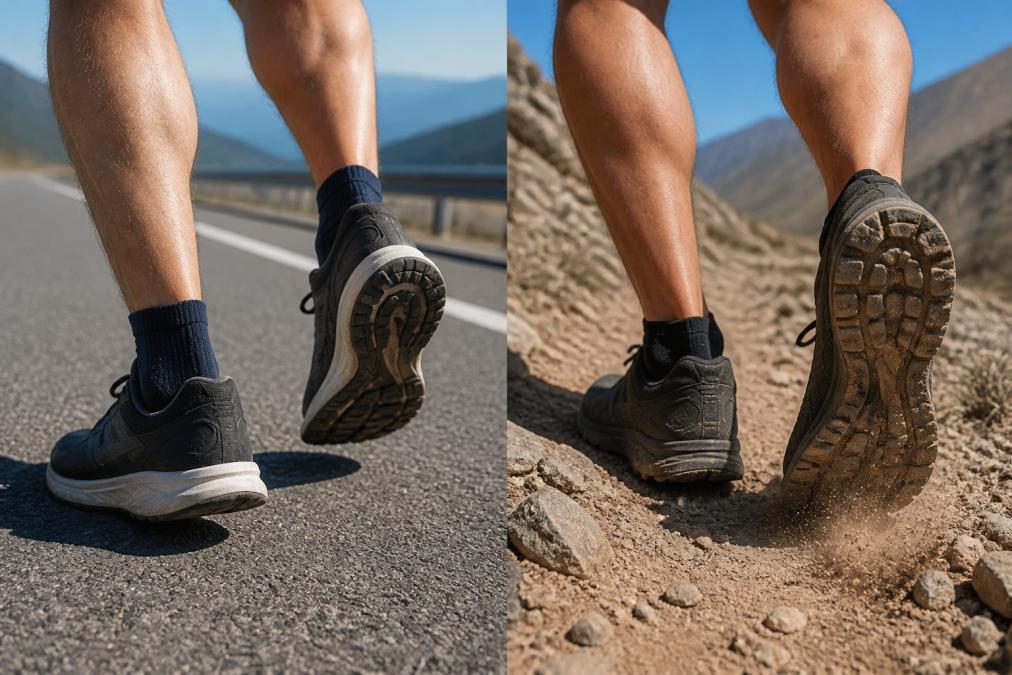
Road and trail running generate fundamentally different friction profiles, and that difference should drive your sock choice more than brand loyalty. Most comparison articles treat "road vs trail" as a cushioning question. It is really a friction-mechanics question, and the two surfaces load the foot in opposite ways.
How Road Surfaces Load the Sock
Pavement and packed gravel produce predictable, repetitive contact. Each footstrike lands at roughly the same angle, at the same cadence, mile after mile. The friction is low-amplitude but high-repetition, concentrated at the heel strike zone and the forefoot push-off zone.
The practical consequence: on road, heat buildup is the dominant stressor, not shear. A thinner sock with light cushioning lets the foot dump heat and reduces the bulk that traps moisture against the sole. Over a marathon, that heat-and-moisture combination softens skin faster than the friction itself does.
How Technical Trails Change the Equation
Technical trails invert the profile. Foot placement is unpredictable, so the foot slides laterally inside the shoe on off-camber rock, loose scree, and root lattices. That lateral shear is the friction that actually causes blisters on trail, and it happens at the collar and along the sides of the foot, not just under the heel.
Three trail-specific stressors matter:
- Lateral shear: side-to-side movement against the sock wall on uneven ground
- Debris intrusion: grit entering at the ankle collar and grinding with every stride
- Point-load impact: sharp rock and root edges concentrating pressure through thin cushioning
A debris-shielding cuff addresses the second stressor directly. Cushioning addresses the third. Nothing in the sock addresses the first except a locked-in fit and a yarn that does not slide against skin when damp.
Why Yarn Weave Matters Differently on Each Surface
Hydrophobic yarns like olefin resist absorbing water, so they stay lighter and slide less against damp skin on humid road races. Softer polyester blends like Drynamix feel better against bare skin out of the box, but they hold more moisture in the yarn structure, which on a technical trail can mean more shear against softened skin.
The takeaway is not that one yarn wins. It is that the yarn that performs best depends on which friction profile your race actually produces. A flat road marathon and a mountain 100-miler are not the same problem wearing different shoes.
Matching Sock to Terrain
| Race Type | Dominant Friction | Sock Priority |
|---|---|---|
| Road marathon | Repetitive heel/forefoot, heat | Thin, hydrophobic, breathable |
| Packed gravel 50K | Moderate repetitive, some grit | Light cushion, secure heel |
| Technical trail 50M+ | Lateral shear, debris, point-load | Debris cuff, moderate cushion, locked fit |
| Mountain 100M | All of the above, cumulative | Debris cuff, compression, spare pairs |
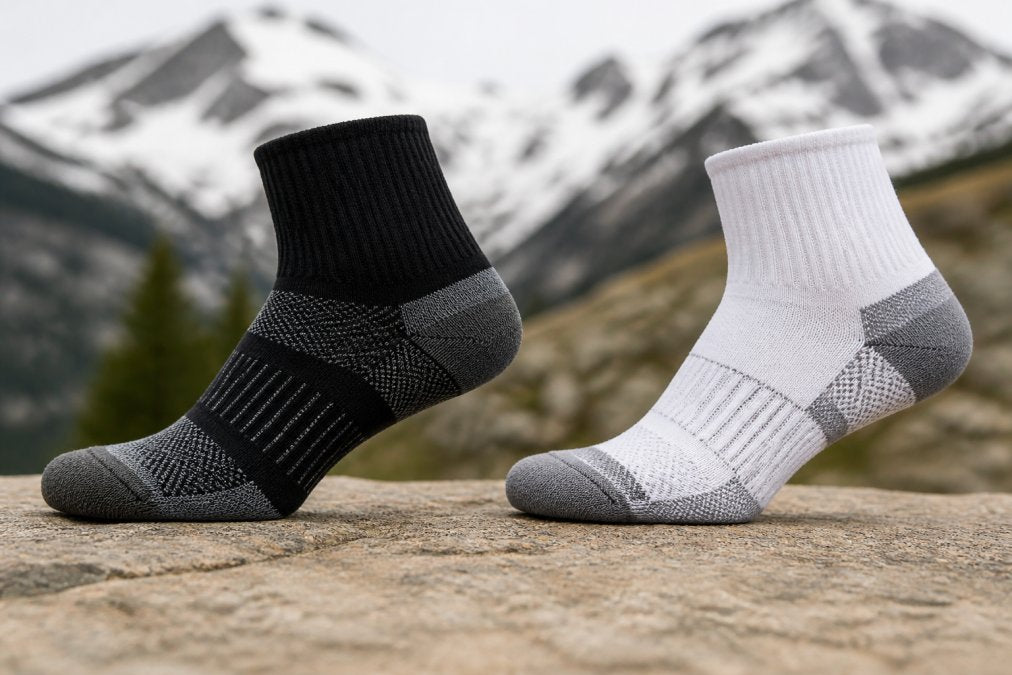
What most guides miss is the collar. Grit entering the shoe at the ankle creates a sandpaper effect with every stride, and no amount of underfoot cushioning fixes it. A debris-shielding cuff, like the patented polyurethane barrier on the RockResist GEN1 Road & Trail Low Cut Athletic Socks, physically blocks that intrusion rather than just cushioning against it.

Sock-to-Shoe Compatibility Matrix
Sock and shoe must work as a system, because a great sock in the wrong shoe still causes problems. Volume is the deciding factor.
| Shoe Type | Recommended Sock Weight | Why |
|---|---|---|
| Minimal road racer | Thin, no-show | Preserves snug race fit |
| Cushioned daily trainer | Light to moderate crew | Fills volume, reduces slip |
| Trail shoe, technical | Moderate with debris cuff | Blocks grit, absorbs impact |
| Wide toe-box shoe | Roomier anatomical fit | Prevents toe crowding |
A common mistake is sizing up a shoe to fit a thick sock. Buy the shoe for your foot, then match sock weight to the shoe's internal volume.
Durability and Wash-and-Wear Degradation
Durability in endurance socks comes down to three variables: yarn quality, reinforcement at high-wear zones, and how you wash them. Heel and toe are where socks physically fail first, so reinforced seams and abrasion-resistant fibers extend usable life. But holes are not what usually retires a premium running sock. Elasticity loss is.
What Actually Degrades First
Most runners assume a sock is done when it develops a hole. In practice, the performance features that justified the premium price, graduated compression, arch support, heel lockdown, fade long before the fabric wears through. A sock can look fine and still be functionally dead.
The degradation sequence typically runs like this:
- Elastic fiber fatigue: spandex and elastane fibers lose recovery after repeated heat exposure, so compression bands go slack
- Cushion compression: foam and terry structures flatten permanently under heel and forefoot load
- Yarn abrasion: heel and toe wear through at the highest-friction contact points
- Collar stretch: the ankle opening relaxes, letting the sock slide and debris enter
By the time a hole appears, the sock has usually been underperforming for dozens of runs.
Why Heat and Softener Are the Real Enemies
Hot water, fabric softener, and dryer heat all attack elastic fibers. Fabric softener coats fibers in a lubricating film that feels nice but reduces the yarn's ability to manage moisture and recover shape. Dryer heat accelerates the relaxation of spandex, which is why socks that go through a hot dryer cycle lose compression noticeably faster than air-dried pairs.
Cold washing and air drying are the two highest-leverage habits for extending sock life. Most practitioners find that this alone meaningfully extends how long compression and fit hold up, often the difference between a sock that feels race-ready after a season and one that feels like a gym sock.
A Practical Wash Protocol
- Wash cold, on a gentle cycle, inside out
- Skip fabric softener entirely, it works against wicking yarns
- Skip bleach and hot-water sanitizing cycles
- Air dry, or tumble on the lowest heat setting if you must
- Rotate at least three to four pairs so no single pair absorbs all the wear
How to Tell When a Sock Is Actually Done
Do not wait for a hole. Retire a running sock when:
- The arch band no longer feels snug against your foot
- The heel slides during a hard push-off
- The collar has visibly relaxed compared to a newer pair
- Cushioning under the heel feels flat compared to when it was new
A useful test is to compare an older pair against a fresh one of the same model on back-to-back runs. The difference in lockdown and cushioning is usually obvious, and it tells you more than a visual inspection ever will.
Verdict: Which Brand Wins for Your Race?
The verdict depends on your foot and your terrain, not brand loyalty. Choose Swiftwick for a snug, compressive, fast-drying fit on technical ground. Choose Balega for plush cushioning and a roomier feel on road races.
For runners who want both debris protection and moisture management in one sock, the RockResist GEN1 Road & Trail Low Cut Athletic Socks combine a debris-shielding cuff with sweat-wicking fibers, tested on rugged Colorado trails. At $25.99, they are built for the friction and grit that road-specific socks ignore.
Frequently Asked Questions
Which running socks are better for comfort and performance, Swiftwick or Balega?
Both brands offer quality endurance racing socks, but they differ in focus. Swiftwick uses a firm compression fit with synthetic Olefin fibers for moisture-wicking and durability. Balega emphasizes plush cushioning with a drynamix polyester blend and seamless toe. For trail runners dealing with debris, neither brand offers a debris-shielding cuff. Consider your priority: compression (Swiftwick) versus cushioning (Balega).
Do Swiftwick socks provide better compression than Balega?
Swiftwick socks are designed with graduated compression, meaning they apply varying pressure from ankle to calf. Balega socks offer a more relaxed, cushioned fit without targeted compression zones. If you need compression socks for endurance running to reduce swelling and improve circulation, Swiftwick is the stronger choice. For pure comfort on shorter runs, Balega may feel less restrictive.
What are the best socks for preventing blisters during ultramarathons?
Blister prevention depends on moisture management, friction reduction, and fit. Look for moisture-wicking synthetic fibers, seamless toe construction, and a snug anatomical fit. For ultramarathons on rugged terrain, consider socks with a debris barrier to keep sand and grit out. RockResist GEN1 Road & Trail Low Cut Athletic Socks feature a patented polyurethane debris barrier that reduces friction at the heel collar, addressing a primary blister cause.
How does material composition affect sock performance in endurance sports?
Material composition directly impacts moisture-wicking, durability, and thermal regulation. Synthetic fibers like Olefin (Swiftwick) and drynamix polyester (Balega) move sweat away from skin. Merino wool blends offer odor resistance and temperature control but dry slower. Nylon and spandex add elasticity and recovery. For endurance racing, prioritize hydrophobic synthetics that stay light when wet and resist abrasion over many miles.
Blisters and debris end more long runs than fitness does, and your sock is the first line of defense. At RockResist, we build gear for exactly that problem: a patented debris barrier, moisture-management fibers, and reinforced seams for endurance. Trusted by athletes across Colorado trails, our socks are designed to keep grit out and keep you moving. Get started with RockResist and race with feet that stay protected from mile one to the finish.