
Table of Contents
- Why Trail Running Demands Different Socks Than Road Running
- Material Matters: Best Moisture-Wicking Materials for Socks
- Preventing Debris in Running Shoes: Sock Height and Cuff Design
- Cushioning, Compression, and Arch Support: Matching Socks to Terrain
- How to Prevent Blisters on Trails: Fit, Friction Reduction, and Seamless Toes
- How to Choose Durable Running Socks: A Step-by-Step Checklist
- Durability, Reinforced Zones, and When to Replace Trail Socks
- Conclusion
- Frequently Asked Questions
Last Updated: September 16, 2026
Why Trail Running Demands Different Socks Than Road Running
Trail running puts your feet through conditions road runners never face: loose gravel, roots, mud, and creek crossings. Learning how to choose durable running socks for trail running starts with one fact: a sock built for pavement will fail you on technical terrain.

Material Matters: Best Moisture-Wicking Materials for Socks
The best moisture-wicking materials for socks fall into two families: merino wool and engineered synthetics. The right pick depends on your climate, sweat volume, and how often you run through water.
How Wicking Actually Works
Wicking is a two-step process: a fiber moves liquid sweat away from your skin, then releases it through evaporation. Hydrophobic fibers, polyester, nylon, polypropylene, push moisture to the outer face of the sock, where airflow dries it. Hydrophilic fibers like merino absorb moisture into the fiber itself, buffering it so your skin never feels soaked, then release it slowly.
Merino Wool vs. Synthetic Fibers
| Factor | Merino Wool | Synthetic Fibers |
|---|---|---|
| Moisture handling | Absorbs and buffers | Wicks and dries fast |
| Drying time (active wear) | Slower, often 60+ minutes | Faster, roughly 20-40 minutes in warm, dry air |
| Durability | Moderate; fine fibers abrade under grit | High; resists abrasion better |
| Odor resistance | Natural | Requires treatment |
| Temperature range | Wide; stays warm when damp | Narrower; feels cold when wet |
| Best for | Cold, wet, multi-day | Hot, dusty, high mileage |
Merino's advantage is temperature regulation across a wide range and natural odor resistance. Its trade-off is durability: fine merino fibers abrade faster than synthetics under constant grit exposure, so pure merino socks often wear through at the heel first.
Blends and Why They Exist
Most trail runners land on a blend, and the reason is structural. A common construction puts synthetic fibers in high-wear zones, heel, toe box, arch, and merino near the skin for comfort and temperature regulation: synthetic durability where grit does its damage, wool comfort where skin is most sensitive.
Drying Time in Field Conditions
For multi-day trail runners, drying time decides whether a sock is usable on day two. Practical patterns most experienced runners follow:
- Rotate pairs, don't wash mid-trip. Carry two or three pairs and alternate; a sock off your foot for a few hours dries faster than one you're sweating into.
- Air-dry outside your pack. Clip socks to the outside of your pack during the day, inside a stuff sack, they stay damp.
- Body heat is your friend. On cold mornings, put damp socks against your skin under a layer; they'll dry faster than in open air.
- Synthetics recover faster than wool. If you're crossing creeks regularly, a synthetic or synthetic-dominant blend dries sooner.
What to Look for on the Label
- Fiber percentages, not just fiber names
- Spandex or elastane content, usually 2-5%, for fit retention
- Nylon reinforcement at heel and toe, which signals durability intent
- Mesh or vented panels over the top of the foot, which speed evaporation
Material choice is the foundation; height, cushioning, and fit build on it.
Preventing Debris in Running Shoes: Sock Height and Cuff Design
Preventing debris in running shoes is mostly a fit problem, not a shoe problem. Grit enters at the collar, the gap between your ankle and the shoe opening, and a taller, snugger cuff closes that gap.
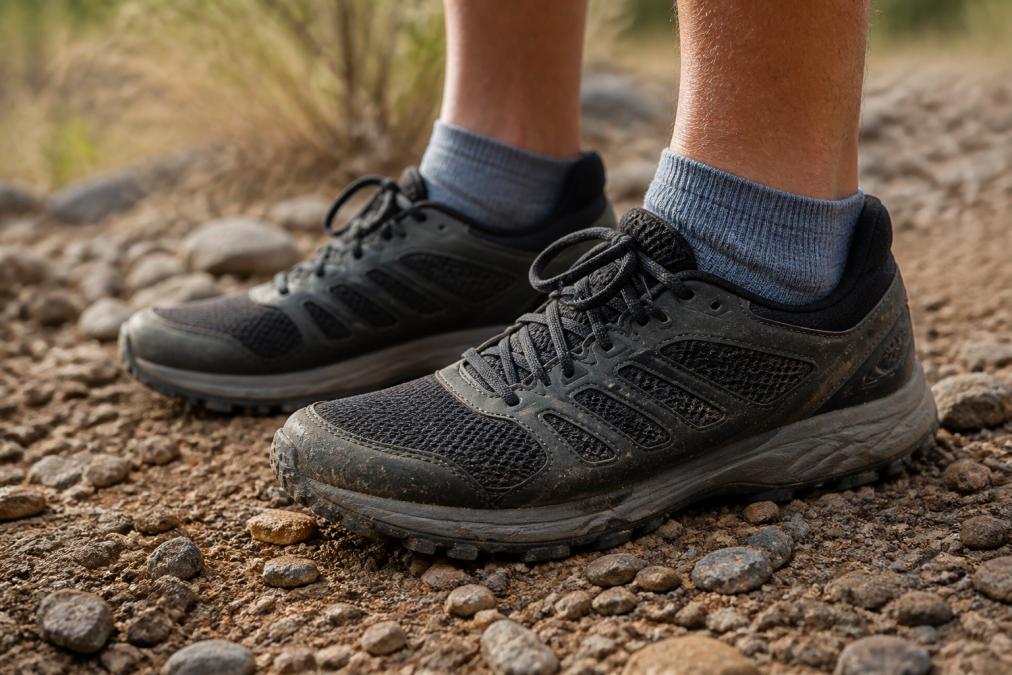
Sock height options each solve a different problem:
- No-show: Minimal coverage, best for smooth packed trails. Offers almost no debris protection.
- Quarter length: Covers the ankle bone, blocks moderate grit, works for most trail conditions.
- Crew length: Full ankle protection, the standard for technical terrain and loose rock.
Cushioning, Compression, and Arch Support: Matching Socks to Terrain
Cushioning and compression should match your terrain, not personal preference alone. Technical, rocky trails reward more cushioning under the heel and forefoot; smooth, fast trails reward less.
Terrain-to-sock matching, in practice:
- Rocky, technical descents: Medium to high cushioning in the heel and toe box. Impact protection matters more than weight savings.
- Smooth, rolling trails: Light cushioning with targeted padding at high-impact areas.
- Mixed terrain: Medium cushioning with reinforced zones at the heel and ball of the foot.
How to Prevent Blisters on Trails: Fit, Friction Reduction, and Seamless Toes
Learning how to prevent blisters on trails comes down to one principle: eliminate friction before it starts. But friction alone doesn't cause blisters, shear force does, and understanding the difference separates a sock that works from one that just sounds technical.
The Mechanism: Shear, Not Just Rubbing
A blister forms when skin is subjected to repeated shear, layers of skin sliding against each other under load. Damp skin is roughly five times more susceptible to shear damage than dry skin, which is why moisture management and blister prevention are the same problem. When your foot slides inside a damp sock, the outer layer sticks to the shoe while the inner layer sticks to your skin, so the shear happens inside your skin. That's the injury.
Four Construction Details That Do the Work
- Seamless toe: Removes the ridge that creates hot spots on long descents. A raised seam concentrates shear force on a single line of skin.
- Snug fit: Prevents bunching and slippage inside the shoe. A sock that moves is a sock that causes shear.
- Reinforced heel: Reduces friction at the collar, where the sock meets the shoe and where grit accumulates.
- Moisture management: Keeps skin dry so it resists shear forces. This is why material choice and blister prevention are linked.
The Fit Rules That Matter Most
- The sock should hug your foot with no wrinkles, but not compress your toes.
- Your heel should not slide when you push off.
- The toe box should have a few millimeters of room, no more.
- The cuff should seal against the shoe collar with no exposed skin.
How to Test Fit Before You Run
Most runners discover a bad fit three miles into a run. Here's a two-minute test you can do at home:
- Put the sock on dry. Check for wrinkles at the heel and under the arch. Any wrinkle becomes a hot spot when wet.
- Put your shoe on and lace it normally. Push your foot forward until your toes touch the front. You should have about a thumbnail's width of space behind your heel.
- Walk on a hard floor for 30 seconds. Your heel should not lift. If it does, the sock is too thin for the shoe or the shoe is too loose.
- Do 10 calf raises. If your toes jam forward, the sock volume is too high for the shoe.
- Simulate a descent. Stand on a step with your heels hanging off, then lower your heels. If your foot slides forward, you'll get black toenails on real descents.
Field Tactics That Actually Work
- Lube before you run. A thin layer of anti-chafe balm on heels and toes reduces shear; reapply at aid stations on long efforts.
- Change socks at the midpoint. On runs over three hours, a dry pair resets your skin's moisture exposure.
- Tape known hot spots. If you always blister in the same place, athletic tape or a blister patch before the run prevents shear from reaching skin.
- Keep grit out. Sand and dust inside the sock act like sandpaper against damp skin, which is why cuff design and debris protection are blister-prevention tools.
- Don't over-tighten laces. A too-tight shoe restricts circulation, making skin more vulnerable to shear damage.
When Fit Isn't the Problem
If you've fixed fit, material, and moisture and you're still blistering, look at shoe volume. A shoe that's too roomy lets your foot slide regardless of sock quality; one that's too tight creates pressure points that become blisters under load. Sock-to-shoe volume matching, covered below, is the variable most runners skip.
How to Choose Durable Running Socks: A Step-by-Step Checklist
Use this checklist to choose durable running socks before your next pair. Work through it in order, and you'll narrow the field fast.
Total time: 10 minutes Difficulty: Beginner
What you'll need:
RockResist GEN1 Trail Running Socks →
-
Your trail shoes
-
A tape measure or your current sock size
-
Your typical run distance and terrain
-
Step 1: Match sock height to terrain. Loose rock and gravel call for quarter or crew length. Smooth trails can take no-show.
-
Step 2: Pick your material. Merino for cold and wet, synthetics for hot and abrasive, blends for everything in between.
-
Step 3: Check the toe and heel. Look for a seamless toe and a reinforced heel. These are the two highest-wear zones.
-
Step 4: Confirm the cuff seals. The sock should close the gap at the shoe collar with no exposed skin.
-
Step 5: Verify the fit. No wrinkles, no heel slippage, a few millimeters of toe room.
-
Step 6: Match sock volume to shoe volume. This is the step most runners skip.
Sock-to-Shoe Volume Matching
Sock-to-shoe volume matching means accounting for how much space your sock takes up inside the shoe. A thick cushioned sock in a snug shoe creates pressure points and restricts toe splay; a thin sock in a roomy shoe lets your foot slide, causing blisters.
Durability, Reinforced Zones, and When to Replace Trail Socks
Signs it's time to replace a pair:
- Thin, translucent patches at the heel or ball of the foot
- Elastic that no longer holds the sock in place
- Pilling or fraying at the cuff
- Persistent hot spots that didn't exist when the socks were new
Most runners replace trail socks based on feel rather than a fixed schedule. When the cushioning flattens and the cuff stops sealing, the protection is gone even if the sock still looks intact.
Conclusion
Choosing the right trail sock is a decision you make once per pair, but it shapes every run that follows. Get the material, height, cushioning, and fit right, and you stop thinking about your feet entirely.
Frequently Asked Questions
What type of socks are best for trail runners?
Trail runners need socks that balance moisture-wicking, debris protection, and durability. Look for materials like merino wool or synthetic blends that pull sweat away from your feet. A higher cuff, such as a crew or quarter length, helps block trail debris from entering your shoe. Cushioning in high-impact areas like the heel and toe box adds comfort on rugged terrain. Reinforced zones at the heel and toe extend the life of the sock, which matters when you are logging long miles on abrasive trails.
How do debris-shielding cuffs improve trail performance?
Debris-shielding cuffs sit above the shoe collar and create a barrier that stops dirt, sand, and small rocks from entering your shoe. When grit gets inside, it rubs against your skin with every step, which leads to blisters and hot spots. A cuff that you can wear up for loose terrain or tuck down for a lower profile gives you flexibility depending on conditions. This small design feature keeps your focus on the run instead of stopping to shake out your shoes.
Why is moisture-wicking material critical for trail running?
Wet feet are more prone to blisters because moisture softens the skin and increases friction inside the shoe. Moisture-wicking materials move sweat away from your skin to the surface of the sock where it can evaporate. Merino wool and synthetic fibers like polyester and nylon are the best moisture-wicking materials for socks because they retain less water than cotton. On long trail runs, dry feet mean fewer blisters, less foot fatigue, and better overall comfort.
How long should running socks last before needing replacement?
Most running socks last between 300 and 500 miles, depending on the material and how often you wear them. Signs it is time to replace them include thinning fabric at the heel or toe, lost elasticity around the arch, and persistent bunching or slippage during runs. Rotating three to four pairs extends the life of each pair because it gives the fabric time to recover between uses. If you notice new blisters forming on routes that never caused problems before, your socks are likely worn out.