

Table of Contents
- Why Foot Powder Matters for Long Distance Running
- Best Foot Powder for Sweaty Feet During Running
- Foot Powder for Blister Prevention on Long Runs
- Foot Powder vs Anti-Chafing Balm: Which Works Better
- How to Use Foot Powder for Running: Application Tips
- Choosing the Right Socks to Work With Foot Powder
- Common Mistakes Runners Make With Foot Powder
- Frequently Asked Questions
Last Updated: October 8, 2026
Why Foot Powder Matters for Long Distance Running
Distance running tests your feet: moisture builds, and friction that feels minor at mile three becomes unbearable by mile fifteen.
This is where foot powder becomes essential. Most runners overlook it, focusing on shoes, socks, and training plans. But foot powder for long distance running solves problems nothing else addresses as directly: sweat management, blister prevention, and moisture control.
Runners often invest in premium shoes and moisture-wicking socks, then skip the one product that keeps everything working. Foot powder isn't an afterthought. It's foundational protection for any run over ten miles.
The mechanics are straightforward: powder absorbs moisture socks and shoes can't manage, reduces friction at pressure points, and creates a drier environment where blisters and fungal issues struggle to develop.
Best Foot Powder for Sweaty Feet During Running
Sweaty feet during running are the predictable output of sustained effort. The question isn't whether your feet will sweat, but how your powder handles that sweat over hours.
Start with the base, because it determines how the powder behaves once it is wet.
Talc. The traditional base. Absorbs moisture fast and feels slick when dry. Its weakness is saturation: once talc takes on enough sweat, it clumps into a paste that stops absorbing and acts like grit.
Cornstarch. Absorbs well and feels smooth, and for many runners it works fine. The trade-off: cornstarch is a carbohydrate, and in warm, damp conditions it can support fungus and bacteria growth.
Silica and slip agents. These additives are why some powders keep their glide after they get damp. Silica particles stay discrete instead of dissolving, so friction reduction holds up longer.
Medicated powders. These add an antifungal such as miconazole or tolnaftate, or an antibacterial agent.
Antiperspirant powders and sprays. Some products pair powder with aluminum-based antiperspirant to reduce sweating rather than just absorb it. These can be effective for heavy sweaters, but can also irritate sensitive skin.
Format matters as much as formulation. Loose powder gives you control over placement and lets you build a visible layer, but it's messy and easy to over-apply.
Fragrance is the ingredient most likely to cause a problem and the least likely to be mentioned. Scented powders can trigger irritation or contact dermatitis on already-stressed skin, and on a long run, irritation compounds. If your feet are sensitive, choose fragrance-free.
Application timing is where most runners lose the benefit. Apply powder to dry skin before your socks go on; powder over damp skin bonds unevenly and clumps.
Foot Powder for Blister Prevention on Long Runs
Most articles treat blisters as a moisture problem that powder solves. That framing is incomplete. Blisters form from three inputs working together: friction, moisture, and shear force. Powder addresses the first two but doesn't eliminate shear, the sideways sliding of skin against sock and shoe every stride.
The mechanism: moisture softens the outer layer of skin, a process called maceration. Softened skin tolerates less friction, so shear force a dry foot shrugs off begins to separate the upper skin layers from those beneath. Fluid collects in that gap, and a blister forms.
So the honest answer to "does powder prevent blisters" is: sometimes, and mostly at the margins. If your blisters come from a consistently damp foot over three or four hours, powder is often the missing piece.
Ingredient choice matters more here than most guides admit. Talc absorbs quickly and feels slick when dry, but clumps into paste once saturated, and clumped powder becomes abrasive grit rather than a lubricant.
| Blister cause | Does powder help? | What else is needed |
|---|---|---|
| Damp skin over multi-hour run | Yes, often decisively | Reapplication at midpoint |
| Shoe too small or too wide | Marginally | Correct fit or lacing |
| Sock bunching or raised seams | No | Seamless, well-fitted sock |
| High shear on descents | Partially | Lubricant balm on hot spots |
| Toe striking the toe box | No | Toe box volume, toe splay |
Hot spots are your early-warning system: heat or a pinpoint sting before any visible damage. When you feel one, stop, dry the area, and apply powder plus, if you carry it, a small amount of lubricant balm directly on the spot. Powder alone on an irritated hot spot can increase stinging because the skin is raw.
One more gap worth naming: powder is not a substitute for addressing a biomechanical cause. If you blister in the same spot on every long run, powder is treating a symptom. Persistent blisters at the same location usually point to shoe fit, foot strike, or a sock that shifts.
Foot Powder vs Anti-Chafing Balm: Which Works Better
Foot powder vs anti-chafing balm comes down to how each manages moisture and friction.
Anti-chafing balms create a protective barrier through oils or waxes. They reduce friction effectively but don't address moisture. As sweat accumulates on a long run, balm becomes slippery and less effective, and it transfers to socks, reducing their moisture-wicking ability.
Foot powder addresses moisture first, then friction, absorbing sweat before it softens skin. That suits distance running, where moisture management is the primary challenge, and powder doesn't interfere with sock performance the way balm does.
For most distance runners, powder outperforms balm on runs over two hours; balm works better for shorter efforts or specific hot spots. Many experienced runners use both: powder across the entire foot, balm on known problem areas where extra lubrication helps.
RockResist GEN1 Trail Running Socks, Debris-Blocking Low Cut →
The practical advantage of powder is that it doesn't require removing your shoes mid-run; you can powder your feet over your socks if needed.
How to Use Foot Powder for Running: Application Tips
The difference between effective foot powder use and wasted effort comes down to technique. Most runners apply powder wrong, then assume the product didn't work.
Start with clean, dry feet. Apply powder directly to skin before socks, focusing on friction-prone areas: between toes, heel, ball of foot, and the sides where your shoe collar contacts skin. Use enough for a visible layer, about a quarter teaspoon per foot. Too little won't last; too much clumps as sweat accumulates.
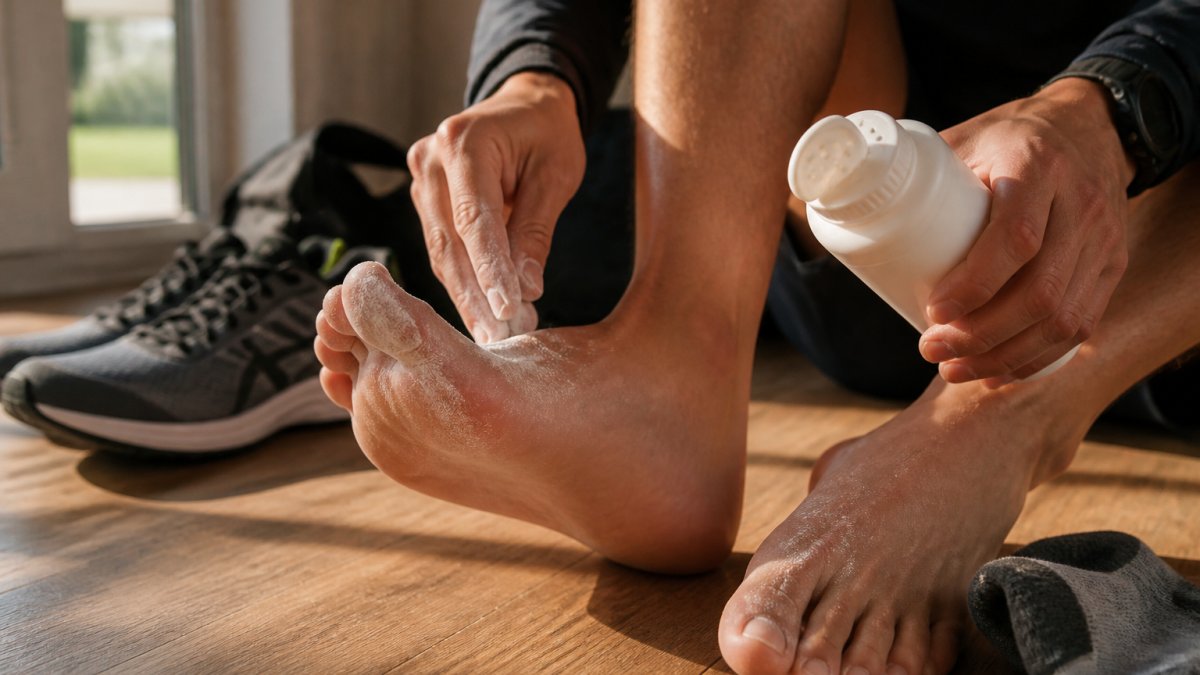
Put on your moisture-wicking socks immediately after applying powder. The powder migrates slightly as you move, but the initial application ensures good coverage. For runs under ninety minutes, this single application usually suffices.
On longer runs, plan for reapplication. Carry a small container or powder packet. At the halfway point, stop briefly and apply powder to areas that feel damp. Focus on pressure points and between toes, where moisture accumulates fastest.
Many runners skip this step because they underestimate how much moisture their feet produce over three, four, or five hours. Distance running isn't a gym workout: sustained effort generates continuous sweat, and that moisture doesn't evaporate, it accumulates in your shoes.
Choosing the Right Socks to Work With Foot Powder
Foot powder works best paired with socks designed for moisture management. Not all socks perform equally, and the wrong choice undermines powder's effectiveness.
Moisture-wicking socks move sweat away from skin toward the outer layer, where it can evaporate or absorb into your shoe. This works better when powder has already reduced baseline moisture at skin level. Cotton socks absorb moisture and hold it, working against powder's benefits. Polypropylene or merino wool socks wick effectively and complement powder's moisture-absorbing properties.
Look for socks with reinforced heel and toe areas. Distance running concentrates pressure there, and extra cushioning reduces friction. Seamless or flat-seam construction matters significantly; raised seams create friction points powder can't fully protect.
Fit is critical. Socks that bunch or shift inside your shoe create friction sources powder can't address. Well-fitting socks stay in place and work with powder to create a stable, protected environment.
RockResist GEN1 Trail Running Socks are engineered for this purpose. The debris-blocking barrier keeps grit out of your shoe, preventing additional friction sources. The added heel material works with foot powder to reduce friction at the collar, one of the most common blister locations on long runs. The non-slip construction keeps the sock in place, so powder stays where you applied it.

For distance running, pairing quality socks with foot powder creates a system greater than either element alone: the socks move moisture efficiently, and the powder reduces it at the source.
Common Mistakes Runners Make With Foot Powder
The biggest mistake is applying powder too late. Many runners wait until they feel moisture or discomfort, but by then skin is already softened and friction has begun. Powder works best as prevention, not treatment, so apply it before the run starts.
Another common error is using too little powder. Runners often apply a light dusting, thinking more powder means more mess, but insufficient powder provides minimal protection. Use enough for a visible layer covering the entire foot surface.
Applying powder over damp feet wastes the product. Moisture prevents powder from bonding to skin and distributing evenly. Dry feet first, with a towel if needed, before applying. This takes an extra minute but dramatically improves effectiveness.
Some runners apply powder then immediately put on damp socks. Moisture from the socks rehydrates powder, reducing its effectiveness. Make sure socks are dry first.
Finally, choosing the wrong powder type limits results. Talc-based powders absorb moisture well but offer less friction reduction. Medicated powders add antifungal protection but may feel thicker. Match each formulation to your specific concerns.
Distance running demands preparation in every detail: shoes, socks, training, and the best foot powder for long distance running all matter equally.
The best foot powder for long distance running is one you'll use consistently, applied correctly before every run. RockResist GEN1 Trail Running Socks pair with quality foot powder to create a protection system built for long efforts. With the right socks, featuring moisture-wicking materials and reinforced pressure areas, and proper powder application, you eliminate one of the most common sources of running discomfort.
Get started with RockResist socks and a proven foot powder routine. Your feet will handle the distance better, and you'll focus on what matters: the run itself. American Academy of Podiatric Sports Medicine guidance on foot care for runners supports preventive approaches like moisture management and friction reduction for distance athletes.
Frequently Asked Questions
Does foot powder help prevent blisters when running long distances?
Yes. Foot powder reduces friction and moisture buildup, two primary blister triggers. By absorbing sweat and creating a dry barrier between skin and sock, powder significantly lowers hot spot development on runs over 10 miles. The key is applying it before moisture accumulates, not after blisters form. Medicated powders with miconazole or tolnaftate also reduce fungal risk in warm, damp conditions.
Should I use foot powder or an anti-chafing balm for long distance running?
Powder and balm serve different purposes. Powder absorbs moisture and reduces friction through dryness; balms create a slick barrier that allows skin to slide without catching. For sweaty feet and moisture management, powder works better. For dry-skin friction, balm is superior. Many runners use both: powder on toes and heels, balm on friction-prone areas. Test both during training to find your preference.
How do you apply foot powder before a long run?
Apply powder before putting on socks, focusing on toes, heels, and the ball of the foot where blisters commonly form. Use a light coating; excess powder clumps and creates new friction points. If using a powder spray, apply in short bursts to avoid over-saturation. For runs over 20 miles, consider reapplying at aid stations or during breaks.
Can foot powder help with sweaty feet and odor during running?
Foot powder controls both sweat and odor by absorbing moisture that bacteria feed on. Talc-based and cornstarch powders are effective for moisture; medicated powders with miconazole or zinc oxide add odor-fighting properties. Moisture-wicking socks amplify powder effectiveness by pulling sweat away from skin. For serious odor issues, medicated powders outperform unmedicated options, though regular application matters more than product type.