
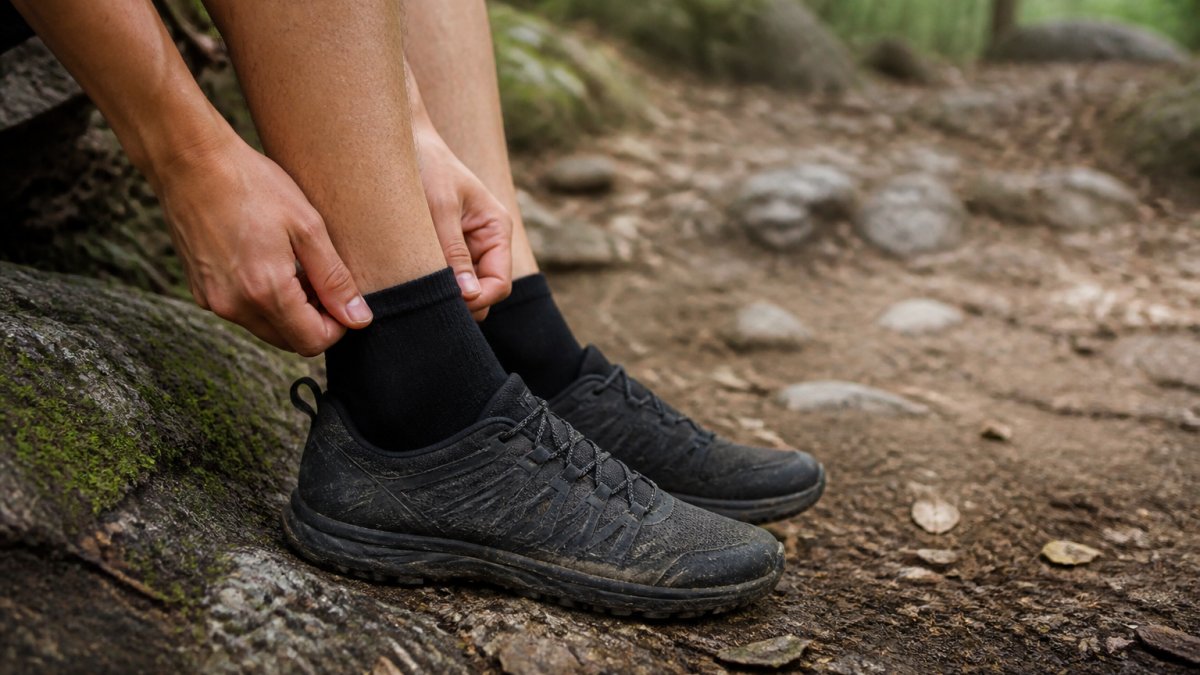
Last Updated: October 29, 2026
Quick Summary
Compression socks apply graduated pressure to your ankle and calf to support circulation, while debris shield socks use a physical collar barrier to help block dirt, sand, and small trail debris from entering your shoe. Choose compression socks for swelling and tired legs, and a debris shield sock for grit and friction at the collar.
- Compression levels are measured in mmHg, with mild roughly 8-15 mmHg and moderate roughly 15-20 mmHg.
- Measure ankle and calf circumference against the manufacturer's size chart, not your shoe size.
- Compression socks don't block debris because the knit is porous by design.
- RockResist GEN1 is 75% cotton and 25% terylene with an integrated collar barrier.
- When layering, start with a thin 8-15 mmHg compression layer and smooth every wrinkle.
Table of Contents
- Compression Socks vs Debris Shield Socks: What Each One Does
- Compression Socks for Hiking: Pressure, Fit, and Real Limits
- Hiking Socks That Keep Dirt Out: The Debris Shield Difference
- Trail Running Socks with Gaiter Cuffs: What to Expect
- Hiking Sock Fit and Sizing: Getting the Ankle and Collar Right
- Can You Wear Compression Socks and Debris Shield Socks Together?
- Which Sock Fits Your Trail Day? A Side-by-Side Decision Guide
- Choose Your Pair and Get Back on the Trail
- Frequently Asked Questions
Compression Socks vs Debris Shield Socks: What Each One Does
Compression socks and debris shield socks address different concerns. Compression socks apply pressure to your lower leg to support circulation. Debris shield socks help block grit from entering your shoe at the collar. RockResist makes the second kind, and this guide explains where each one may fit in your gear rotation.
Here is the short version: one sock is designed to apply pressure, the other to help block dirt.
How Compression Socks Work
Compression socks are knit garments that squeeze your ankle and calf in a measured gradient, tightest at the ankle and looser as they rise. That pressure helps push blood back up toward the heart, which is why people wear them on long flights or after a hard effort. The squeeze is measured in mmHg, and the level matters more than the brand name. A mild sock feels like a firm hug; a medical-grade stocking feels like a tourniquet by comparison.
How Debris Shield Socks Work
RockResist GEN1 has an integrated barrier that helps block dirt, sand, and small trail debris from entering at the shoe collar. The barrier can be worn up for loose terrain or tucked in for a lower-profile look.
| Feature | Compression Socks | Debris Shield Socks |
|---|---|---|
| Main job | Support circulation | Block dirt and grit |
| How it works | Graduated pressure | Physical collar barrier |
| Measured in | mmHg | Not applicable |
| Best for | Swelling, travel, recovery | Trail running, hiking |
| Medical use | Yes, at higher levels | No |
Compression Socks for Hiking: Pressure, Fit, and Real Limits
Compression socks and debris-blocking socks address different concerns. A compression sock does not provide the integrated collar barrier described for RockResist GEN1.
How the pressure actually works
A common way the range breaks down:
- Mild (roughly 8-15 mmHg): everyday tired-leg and travel support; easy to put on and comfortable for long wear.
- Moderate (roughly 15-20 mmHg): the range many recreational hikers and runners reach for on long days.
- Firm (roughly 20-30 mmHg and up): typically sold as medical-grade and often fitted with clinician guidance.
Exact thresholds vary by manufacturer, so read the label rather than assuming a sock is "mild" because it feels soft.
Fit is where compression socks live or die
Measure your ankle and calf circumference and match them to the manufacturer's size chart rather than buying by shoe size. Calf circumference is the measurement most people skip, and it's the one that most often puts a buyer in the wrong size.
The limits worth knowing before you buy
- They don't block debris. The knit is porous by design; grit passes through the collar opening regardless of how tight the sock is.
- They aren't a substitute for medical care. If you have a circulation condition, diabetes, or a history of venous issues, talk to a clinician before choosing a compression level. The CDC guidance on venous health is a reasonable starting point for understanding what compression can and cannot do.
- Higher pressure isn't automatically better. More mmHg means more support and also more difficulty putting the sock on, more heat, and a greater chance of discomfort if the fit is off.
If your problem is swelling and tired legs, compression is the tool. If your problem is grit and friction at the collar, it isn't, and that's where a debris shield sock earns its place.
Hiking Socks That Keep Dirt Out: The Debris Shield Difference
RockResist GEN1's integrated barrier helps block dirt, sand, and small trail debris from entering at the shoe collar.
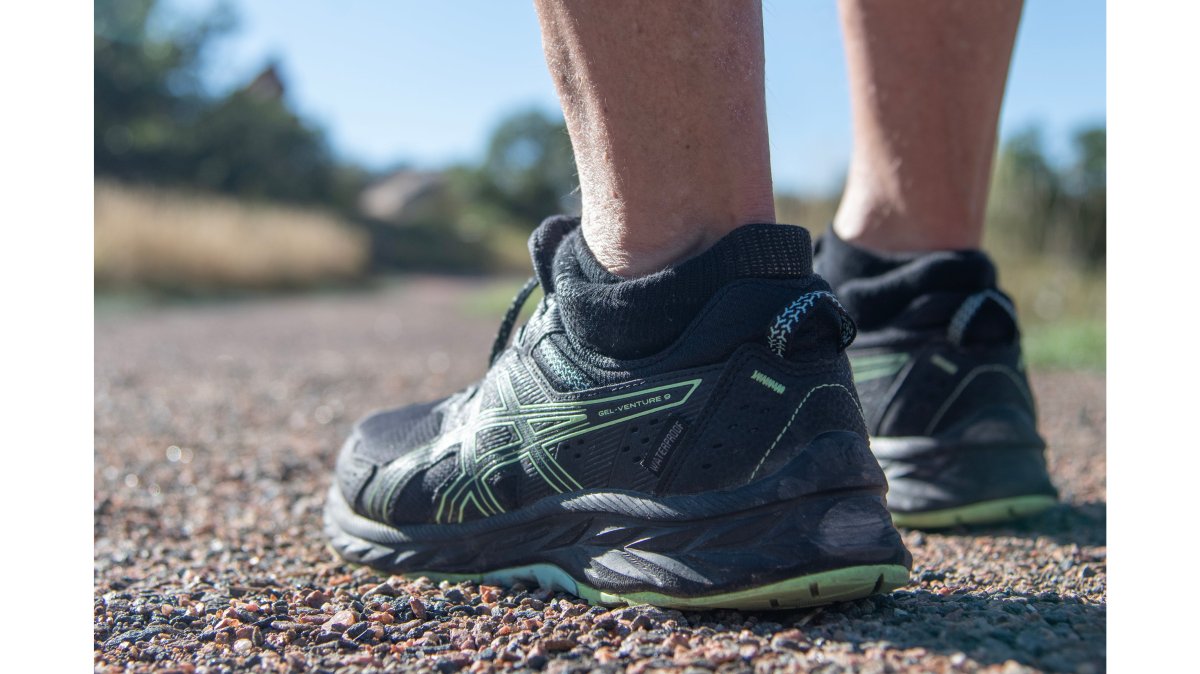
That is the design behind the RockResist GEN1 Trail Running Socks, Debris-Blocking Low Cut. The integrated barrier helps block dirt, sand, and small trail debris from entering at the shoe collar. Wear it up on loose terrain or tuck it in for a lower-profile look. The sock is 75% cotton and 25% terylene, with added heel material to help reduce friction at the collar.

Trail Running Socks with Gaiter Cuffs: What to Expect
Trail running socks with gaiter cuffs borrow a page from gaiters, the fabric shields that strap over a shoe. The idea is the same: extend coverage above the collar so debris has nowhere to land.
Expect a few trade-offs. A taller cuff adds a little warmth and can feel odd under a tight pair of tights. It also needs to sit flush against the shoe, or grit will sneak under the edge anyway. For a fuller look at keeping shoes clean, see our guide on how to stop dirt getting inside hiking shoes. Sock barriers work best alongside good shoe fit and, where needed, a proper gaiter.
RockResist GEN1 Trail Running Socks, Debris-Blocking Low Cut →
Hiking Sock Fit and Sizing: Getting the Ankle and Collar Right
Hiking sock fit and sizing come down to two measurements: your foot length and your ankle circumference. Get the length right and the collar wrong, and you will feel it within a mile.
A collar that is too tight digs in. One that is too loose slides down and lets grit in. Check the manufacturer's size chart rather than guessing, especially if you sit between sizes. Our guide on how to size performance socks walks through the ankle and collar check in detail.
- Measure your foot at the end of the day, when it is largest
- Check ankle circumference, not just shoe size
- Confirm the collar sits above the shoe edge, not under it
- Wash and dry per the label to protect the elastic
Can You Wear Compression Socks and Debris Shield Socks Together?
You can wear compression socks and debris shield socks together, but layering has a cost, and the cost is almost always fit. Two socks add bulk inside the shoe, and bulk changes everything: toe box room, heel lock, and where the collar sits against your ankle. A shoe that felt perfect with one thin sock may feel tight with two.
This is the question most comparison articles skip, so here is the practical framework.
What layering actually changes
- Volume inside the shoe. A compression layer plus a debris shield layer can push your foot against the upper and shorten the effective length of the shoe. If your toes were already close to the front, layering will make that worse.
- Pressure stacking. A compression sock applies its own gradient; a second sock over it doesn't add compression, but it can add friction and bunching at the ankle and collar. Bunching is the enemy, a fold behind the heel or under the collar becomes a rub point fast.
- Collar interference. The debris shield barrier needs to sit flush against the shoe opening to do its job. A compression sock underneath can change how the barrier sits, letting grit sneak under the edge.
- Heat and moisture. Two layers trap more warmth, which matters on hot days and long efforts.
A practical layering checklist
- Start with a thin compression layer. A mild sock in the 8-15 mmHg range adds support without much bulk.
- Put the debris shield sock on over it and smooth out every wrinkle at the ankle and collar before you put the shoe on.
- Check the collar. The barrier should sit above the shoe edge, not folded under it.
- Re-lace and re-check fit. If your toes touch the front or the heel slips, the layering isn't working in that shoe.
- Size up the shoe if needed, or accept that the combination isn't right for that pair.
- Test on a short outing first. A mile in the driveway beats discovering a rub point at mile eight.
When a purpose-built sock is the better answer
If your main problem is debris and grit, a single debris shield sock does that job without the bulk penalty, the RockResist GEN1 Trail Running Socks, Debris-Blocking Low Cut is built around a collar barrier that helps block dirt, sand, and small trail debris, with the barrier worn up on loose ground or tucked in for a lower profile. If your main problem is swelling and tired legs, a single compression sock does that job. Layering is for the days you genuinely need both, and it works best when you treat it as a fit decision, not a default.
For a deeper look at the trade-offs, read our comparison of sweat-wicking vs debris-blocking sock functions.
Which Sock Fits Your Trail Day? A Side-by-Side Decision Guide
Which sock fits your trail day depends on what is actually bothering your feet. Use this quick framework before you buy.
- Sand, pebbles, and grit at the shoe collar: RockResist GEN1's integrated barrier helps block dirt, sand, and small trail debris.
For a direct comparison of sock types, our guide on trail running socks vs standard athletic socks lays out the differences. The American Podiatric Medical Association is a useful resource if foot pain or circulation is a recurring concern.
Choose Your Pair and Get Back on the Trail
Most trail foot problems trace back to one of two causes: pressure and flow, or grit and friction. Knowing which one is slowing you down is the whole game. Compression socks handle the first. Debris shield socks handle the second.
At RockResist, we built the GEN1 around the debris problem, with a collar barrier that helps keep grit out and a fit that stays put on high-movement runs. If grit is your issue, view RockResist socks and sizing to find your pair and check current details. Get started with RockResist and keep your focus on the trail, not your socks.
Frequently Asked Questions
What is the difference between compression socks and debris shield socks?
Compression socks apply pressure. RockResist GEN1 has an integrated barrier that helps block dirt, sand, and small trail debris from entering at the shoe collar. The barrier can be worn up for loose terrain or tucked in for a lower-profile look.
Are compression socks useful for hiking?
Compression socks and debris-blocking socks address different concerns. RockResist GEN1's integrated barrier helps block dirt, sand, and small trail debris from entering at the shoe collar.
Can you wear compression socks with hiking socks?
Yes, some hikers layer a thin compression sock under a hiking sock. The trade-off is added bulk and heat inside the shoe, which can change fit. Check that your shoe still has room at the toe box and collar. If you layer, test on a short hike first and watch for pressure points or bunching at the ankle.
Do debris shield socks keep dirt and sand out of shoes?
RockResist GEN1 has an integrated barrier that helps block dirt, sand, and small trail debris from entering at the shoe collar. The barrier can be worn up for loose terrain or tucked in for a lower-profile look.
